COLUMBUS, MARCONI, BALBO AND MUSSOLINI: Italian Heroes Collide in Chicago - Part 1
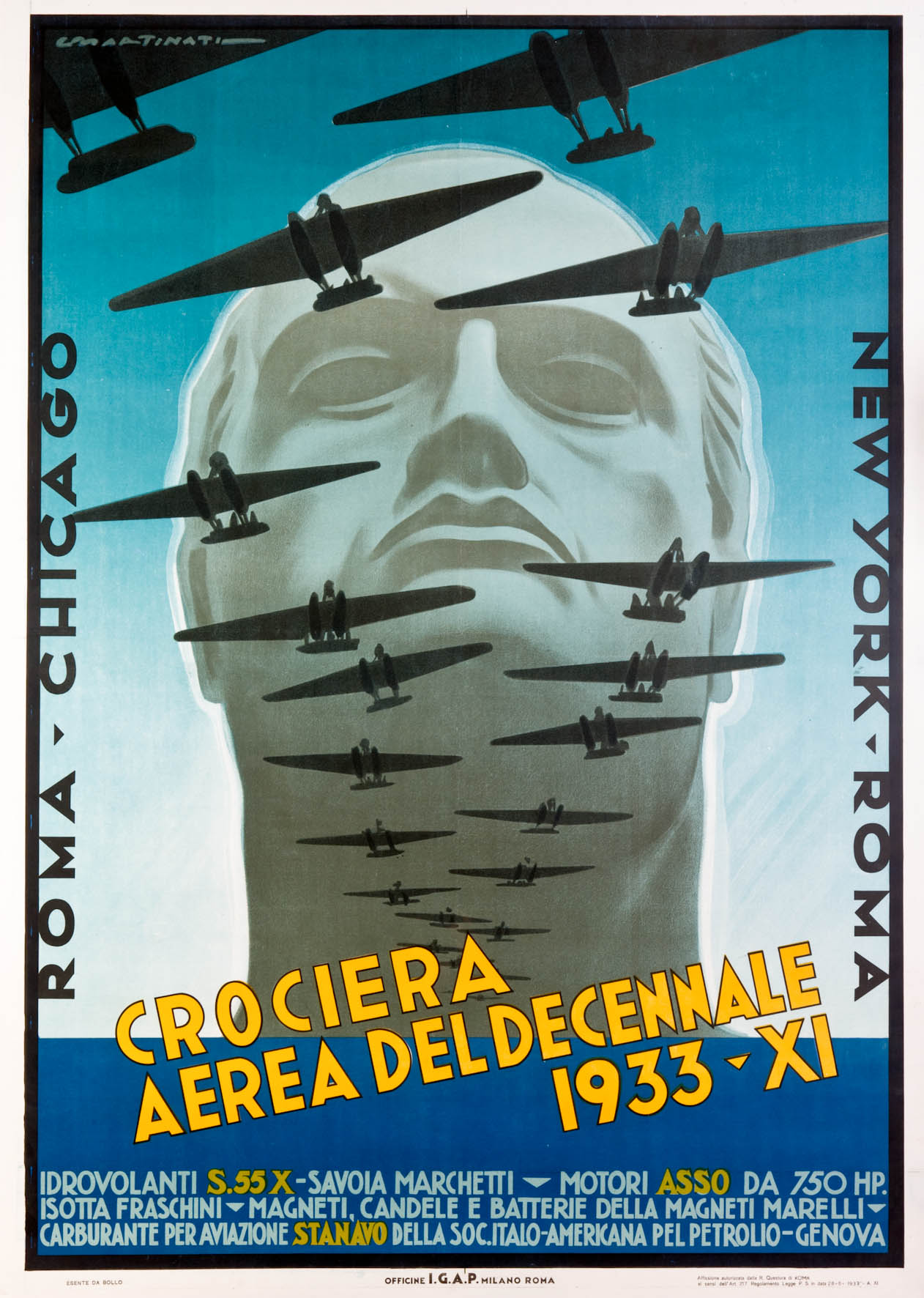
CONTENTS:
(1) THE VIEW FROM MARCONI PLAZA (PHILADELPHIA)
(2) MARCONI-MANIA vs. BALBO-MANIA (CHICAGO)
(3) ITALO BALBO AND THE COLUMBUS THING
(4) MY HERO!
FOR MORE GUGLIELMO MARCONI, SEE:
GUGLIELMO MARCONI: Science, Fascism, Antisemitism and What Else?
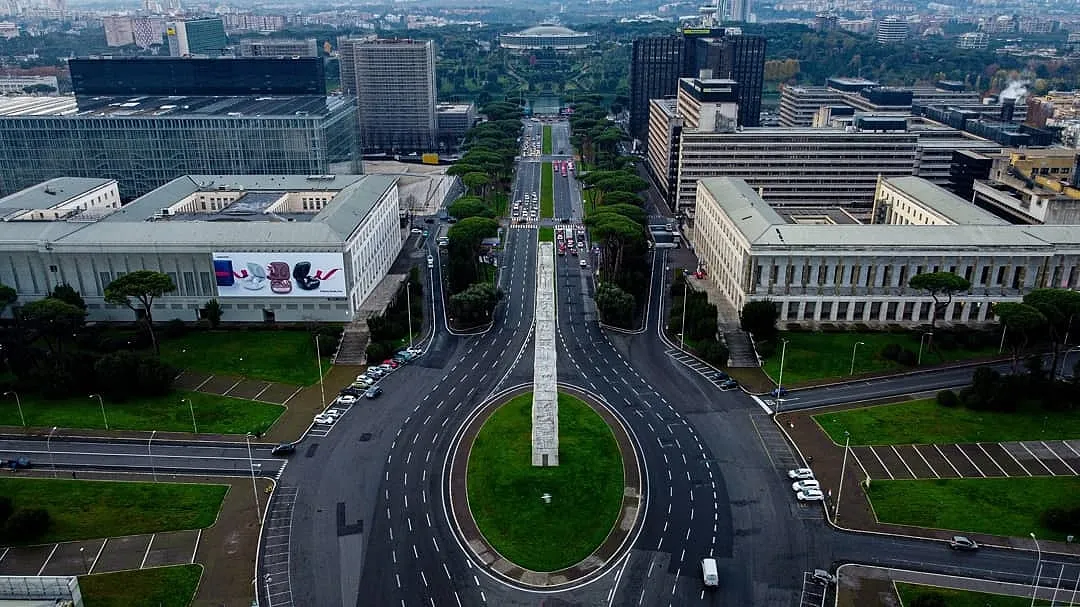
FOR THE STORY OF ROME'S EUR QUARTER, SEE:
E.42: Mussolini's Fascist Theme Park on the Outskirts of Rome
FOR MORE OF THE CHICAGO CENTURY OF PROGRESS STORY, SEE:
COLUMBUS, MARCONI, BALBO AND MUSSOLINI: Italian Heroes Collide in Chicago - Part 2
COLUMBUS, MARCONI, BALBO AND MUSSOLINI: Italian Heroes Collide in Chicago - Part 3
COLUMBUS, MARCONI, BALBO AND MUSSOLINI: Italian Heroes Collide in Chicago - Part 4
(1) THE VIEW FROM MARCONI PLAZA (PHILADELPHIA)
History is written by the victors.
They also name the streets.
After the collapse of the Fascist Regime, its democratic successors scratched out Via dell'Impero (Empire Street) and Piazza Imperiale (Imperial Square). Then they swapped in Via Cristoforo Colombo (Christopher Columbus Street) and Piazza Marconi (Marconi Square).
An easy decision —it would seem— pairing a bold explorer and a brilliant scientist. Who could possibly object to schoolbook heroes of that sort?
Then the wheel of history turned, yet again. Christopher Columbus now raises even more ire than Benito Mussolini. But somehow, Guglielmo Marconi still enjoys a free pass.
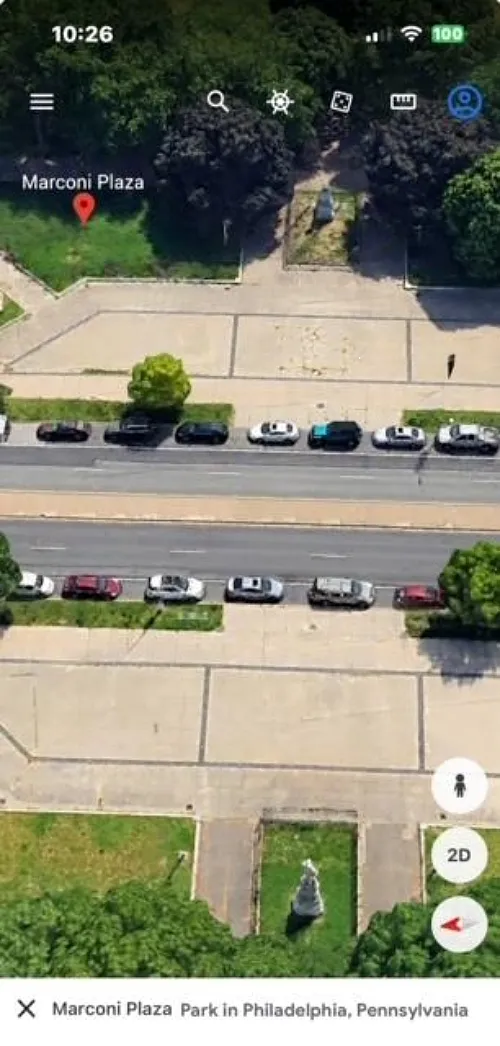
Christopher Columbus and Guglielmo Marconi have long kept company, in public spaces wherever we go. We can imagine them communing across time and space—here represented by South Broad Street—in a medium-sized park in South Philadelphia.
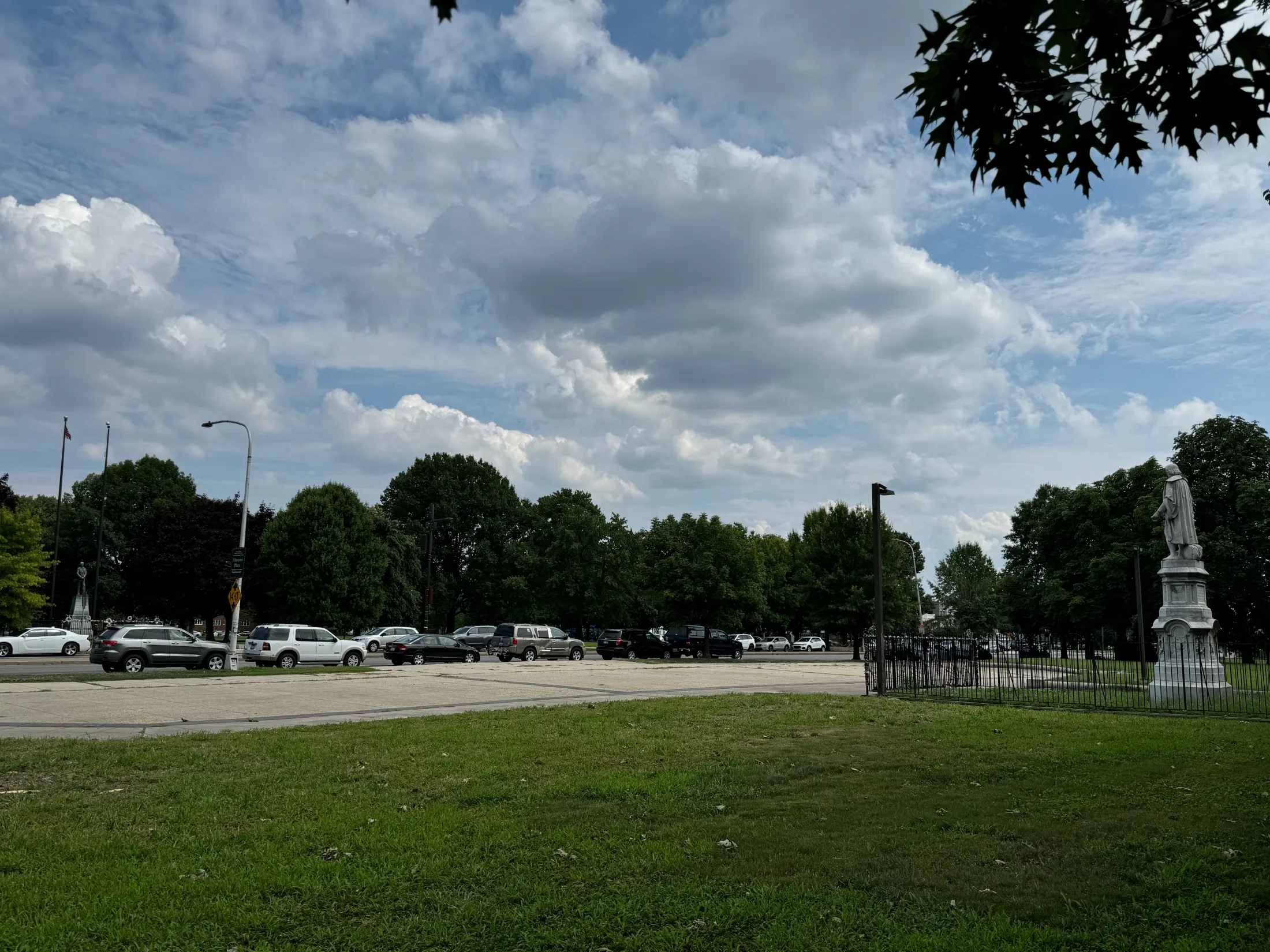
A tale of two statues: Guglielmo Marconi, far left (between the flag poles) and Christopher Columbus, right.
An odd couple or not? It depends on how you read the past. South Philly is an Italian-American neighborhood with a long memory. And when it comes to history, there is more than enough to go around.
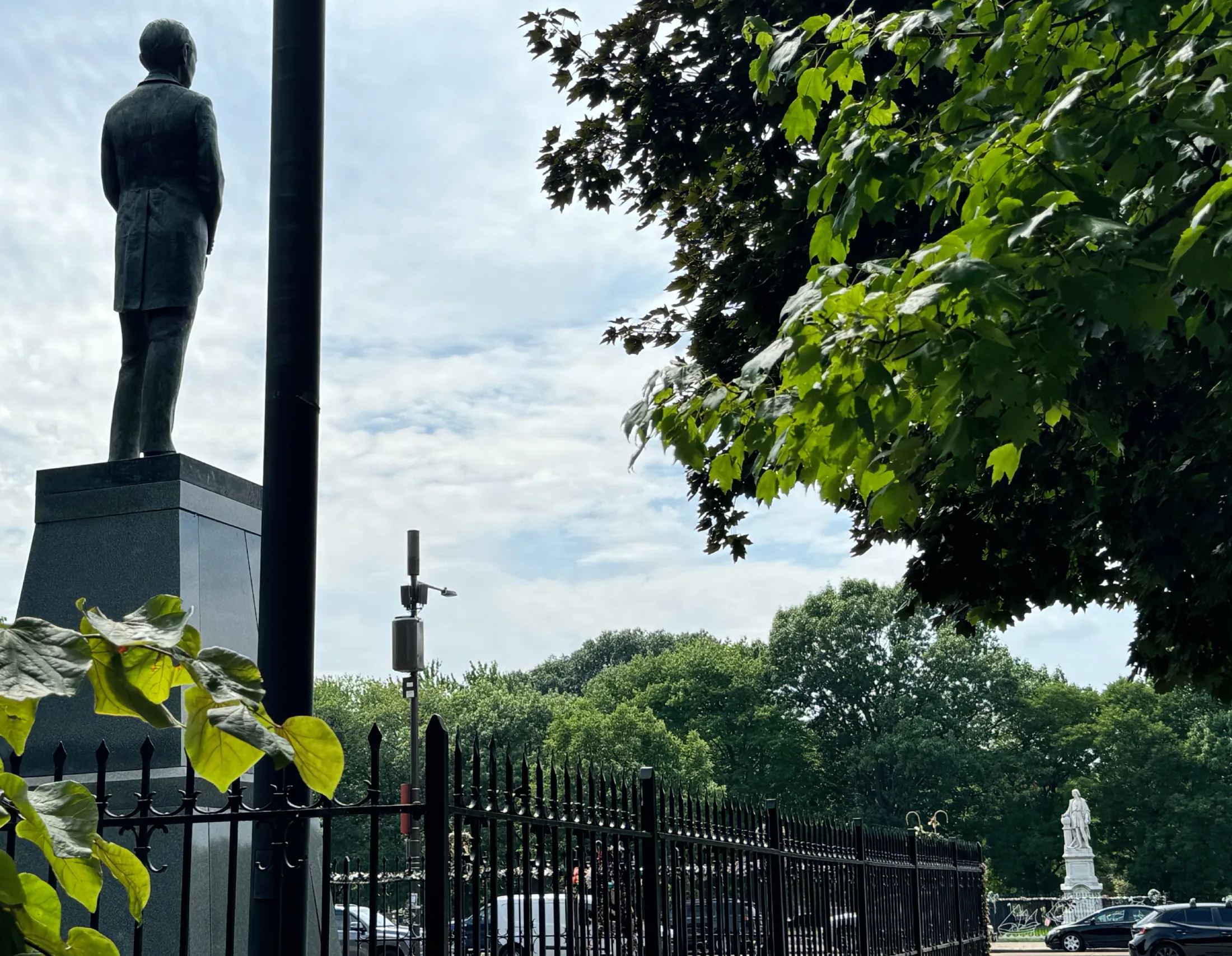
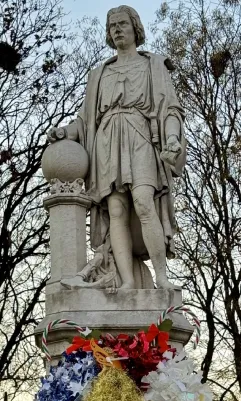
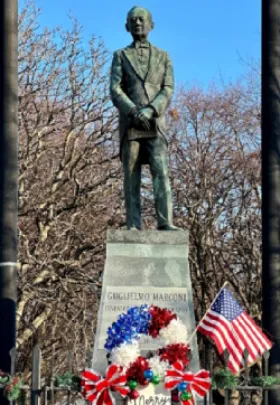
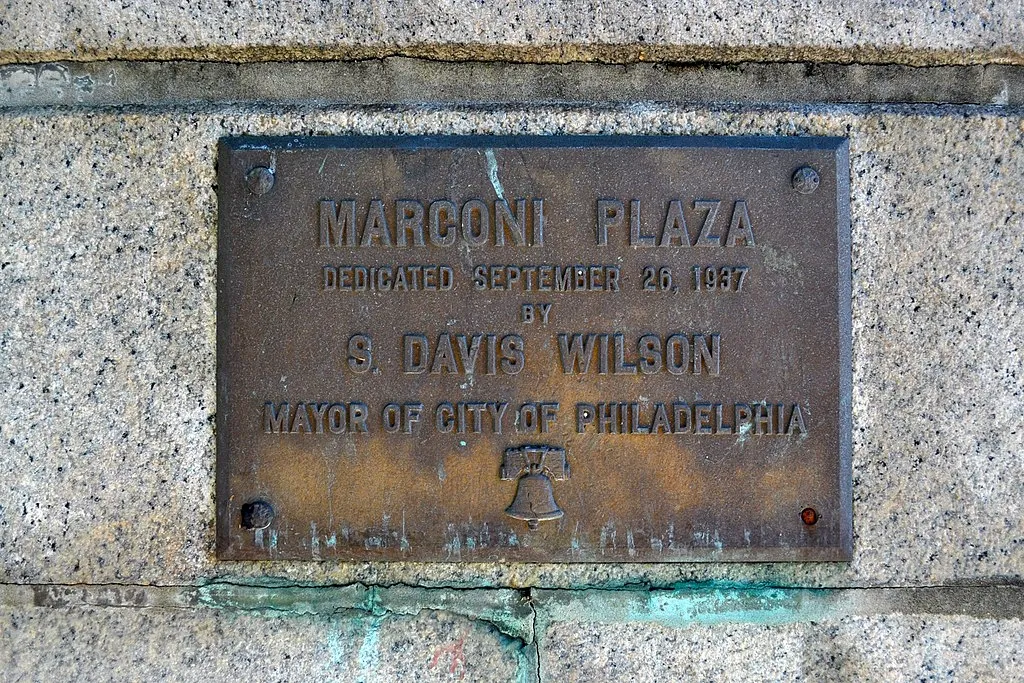
In fact, the statues of the explorer and the scientist are both relatively recent arrivals. Marconi appeared on this spot only in 1975, then Columbus a year later in 1976.
FOR PHILADELPHIA'S HISTORIC COLUMBUS STATUE, SEE:
WHOSE COLUMBUS? WHOSE COLUMBUS DAY? Part 1: It begins with a statue in Philadelphia in 1876
At that time, Marconi Plaza was nothing new—dedicated nearly forty years earlier, on September 26, 1937. Barely three months had passed since the inventor's death, astonishing speed for any government administration.
The late scientist was both a public hero and a household word, with "Marconi" and "radio" virtually synonymous. At that time, Marconi monuments were rushing into production around the country and around the world.
For Philadelphia's city fathers, the solution was cheap and easy. They already had the park— right there in their preeminent Italian neighborhood. So, all they needed was a fresh plaque.
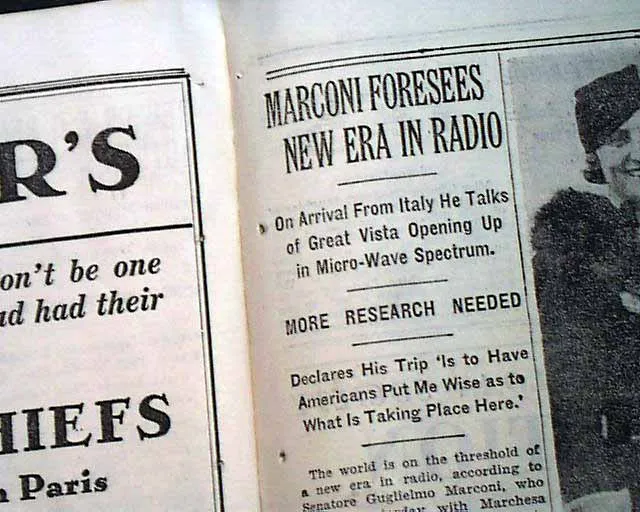
Stopping in NYC on his way to the Century of Progress Exposition in Chicago, Marconi "declares His Trip 'is to Have Americans Put Me Wise as to What Is Taking Place Here.'"
(2) MARCONI-MANIA vs. BALBO-MANIA (CHICAGO)
Working the press and generating headlines around the world was an essential part of Marconi's job —as President of the Royal Italian Academy.
According to its charter:
The scope of the Italian Academy is to promote and coordinate the arts and letters, to preserve their pure national character according to the spirit and traditions of this lineage, while favoring their expansion and influence beyond the borders of this state.
"Have Americans put me wise..." How is that for reading the room?!
Openness and international cooperation were Marconi's chief themes and he was fluent in both English and the jargon of Transatlantic Business.
From 1899 to 1919, his Marconi Wireless Telegraph Company of America had been based in New Jersey (until its forced sale to the Radio Corporation of America).
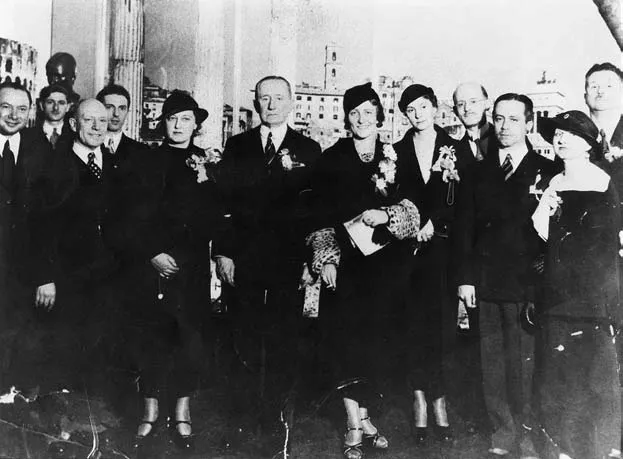
The Marconi delegation (with the Marchese and the Marchesa Marconi in the center) poses in front of a view of the Roman Forum on October 3, 1933.

DUX (Duce).
ROMA CAPUT MUNDI (Rome Capital of the World).
XI (1933 was Year Eleven of the Fascist Era).
Over their heads —just out of camera range— looms the commanding profile of Mussolini himself.
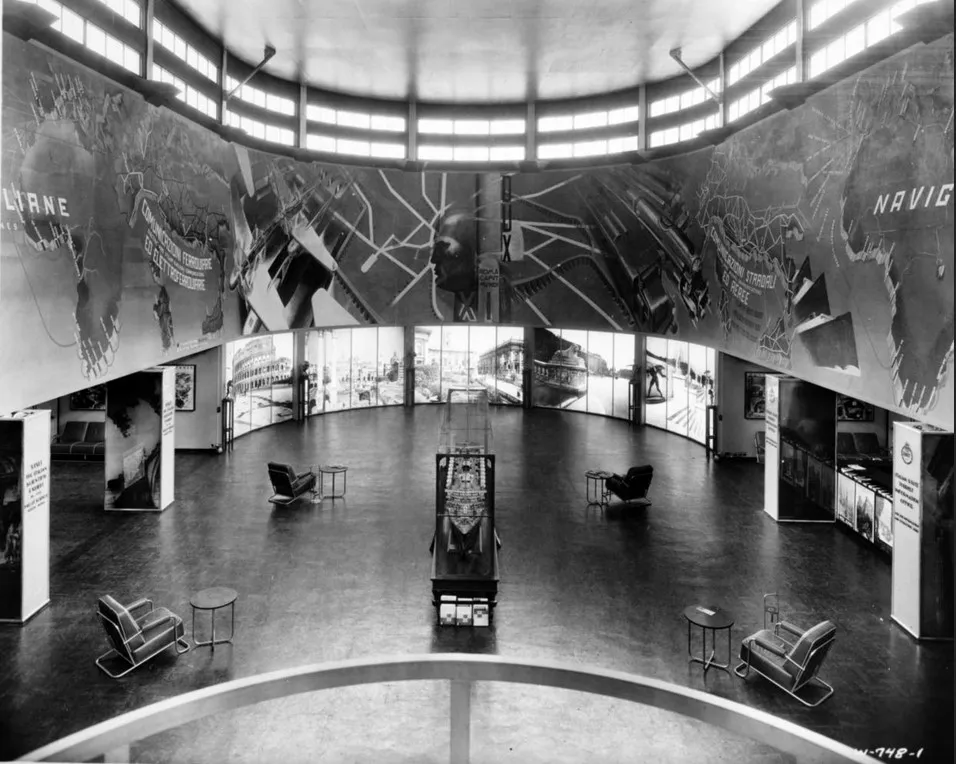
The Italians staged a massive public relations blitz at the Century of Progress International Exposition in Chicago. Guglielmo Marconi played a starring role but he wasn't the hottest ticket in town.
The unrivaled headliner was Italo Balbo —then relatively young (37 years old in 1933), compellingly macho and a legendary hero of the Fascist Movement.
One of Mussolini's oldest allies, Balbo helped mobilize the 1922 March on Rome —the brilliant stunt that propelled his mentor to the forefront of Italian politics.
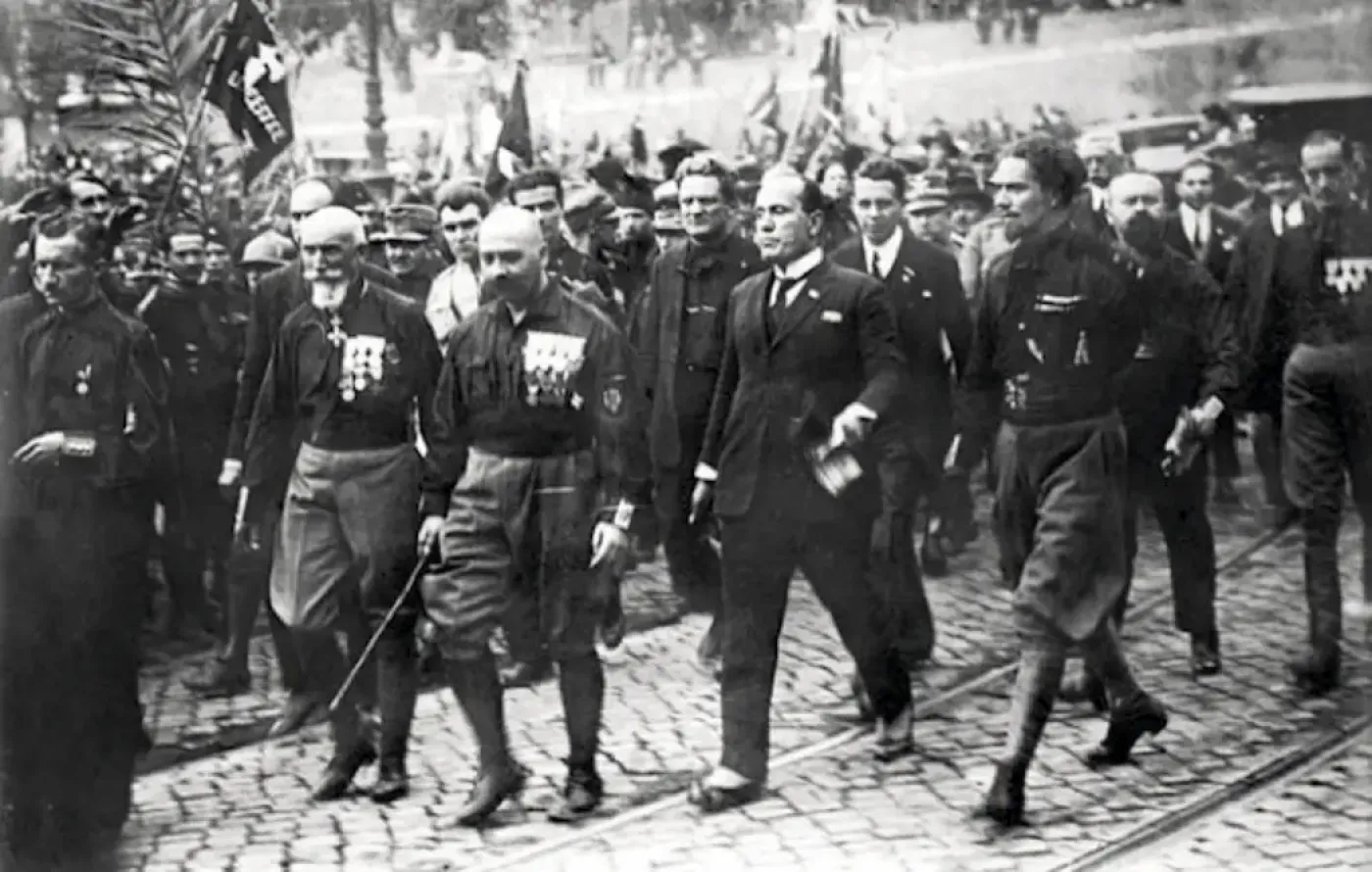
Italo Balbo captivated the camera with his romantic revolutionary style.
Grand-style bravado was Balbo's special thing and looking back, the March on Rome now seems a relatively home-spun production.
In the years that followed, he emerged as a daring pilot whose aerial exploits entranced the public— first-ever long-distance flights and elaborate choreographies in the sky.
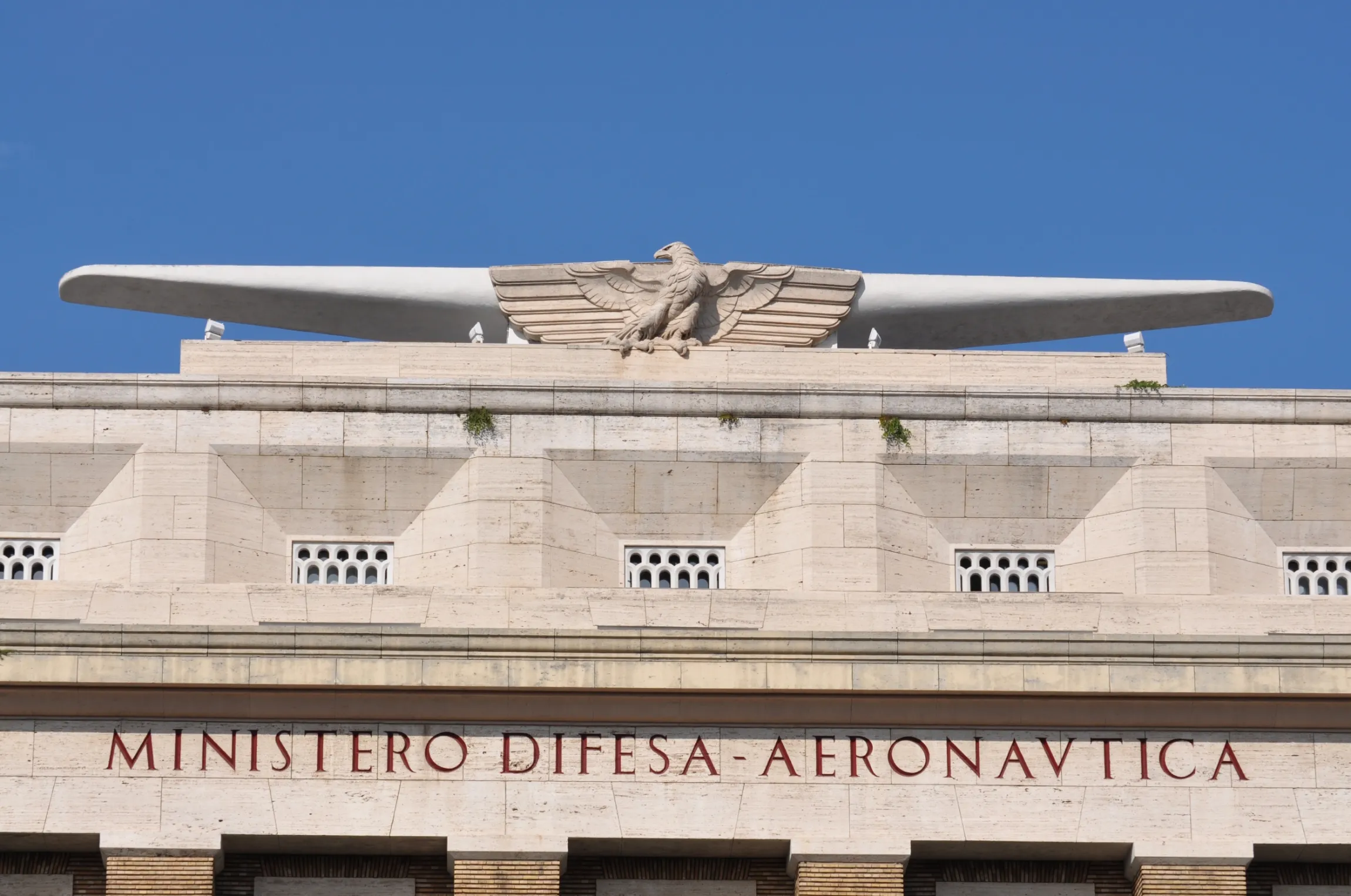
The Ministry of Aeronautical Defense is the quintessential Balbo Monument in Rome, surmounted by an ingenious Eagle-Airplane emblem.
In 1929, the Duce appointed Balbo Minister of Aeronautics, putting the entire Air Force at his disposal.
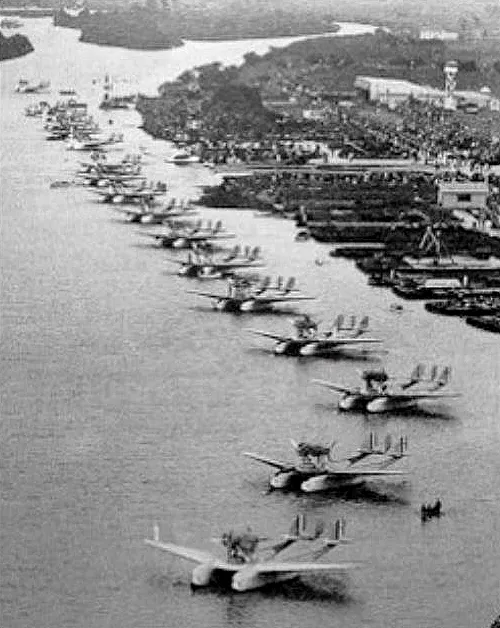
Italo Balbo's amphibious vehicles prepare to depart for Chicago and the Century of Progress Exposition.
Chicago's Century of Progress Exposition seemed made-to-order for the Mussolini Regme, since that same century also saw the Unification of Italy and the emergence of the Fascist Corporate State.
Balbo rose to the occasion and then some— captaining a fleet of 24 seaplanes on a 6,000 mile journey from the Italian coast to the shore of Lake Michigan.
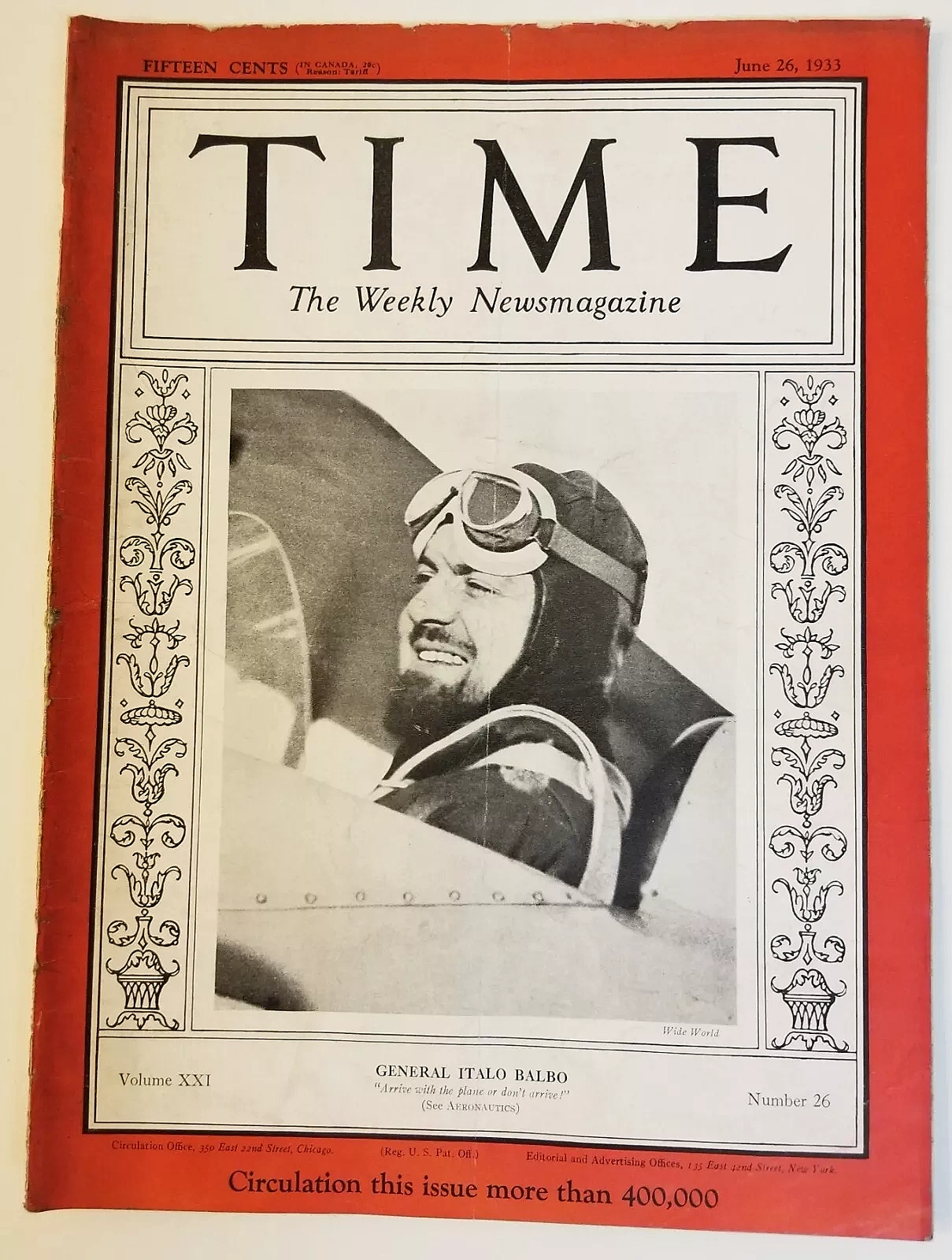
The smiling celebrity pilot is elegantly framed by Italian Renaissance motifs: "Arrive with the plane or don't arrive!" is seemingly the 20th-century equivalent of the Spartan maxim,"Return with your shield or on it".
Media coverage was extensive, eager and stunningly superficial —for us today. Time Magazine gave Balbo their cover and nearly 2,200 words, exuding glib admiration for his aeronautical prowess, amidst droll "insights" into Italian customs and Catholic superstitions.
When it came to politics, we might describe the article as "Fascism-curious". Time lingers over titillating details of coercive violence and Machiavellian intrigue, but plays it all for a laugh.
Ultimately, the whole "Mussolini Thing" disolves into a picturesque blur of local color.
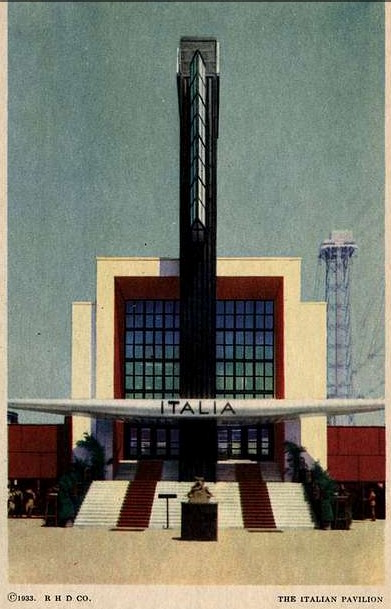
Italo Balbo made the most of the extraordinary creative resources of the Fascist Regime.
When it came to architecture, he could draw a straight line from his Ministry of Aeronautics in Rome (1929-31) to Italy's aeronautically-minded National Pavillion in Chicago (1933).
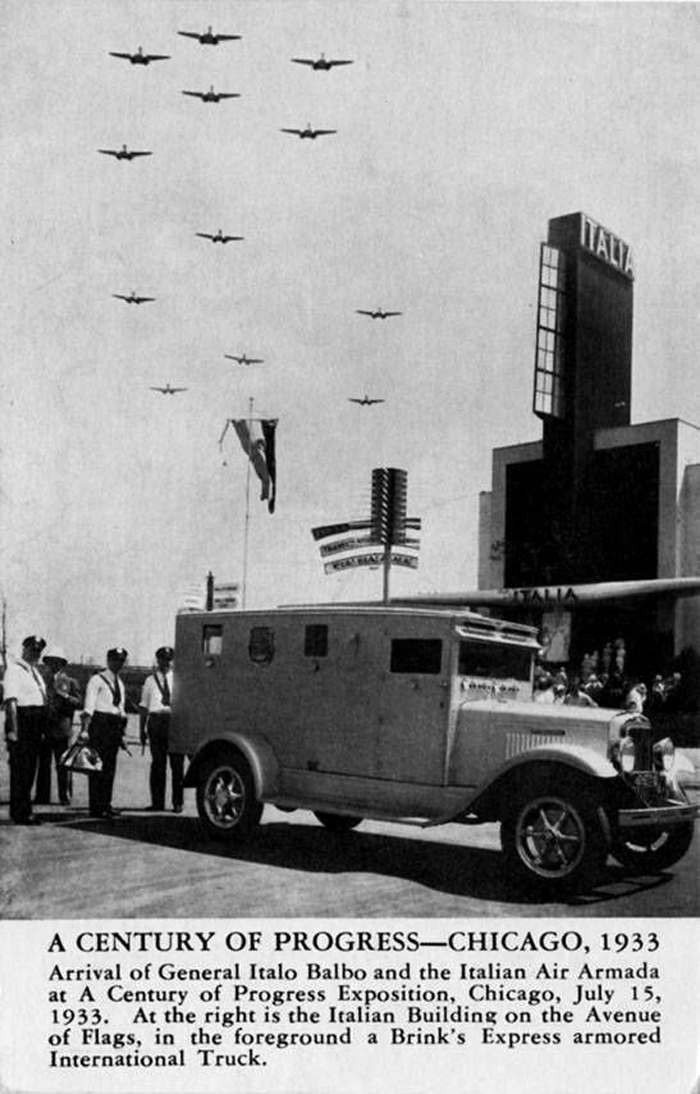
"A CENTURY OF PROGRESS —CHICAGO, 1933: Arrival of General Italo Balbo and the Italian Armada at A Century of Progress Exposition, Chicago, July 15, 1933. At the right is the Italian Building on the Avenue of Flags, in the foreground a Brink's Express armored International Truck."
For those on the ground, the message could not have been more emphatic —nor Italian showmanship more breath-taking.
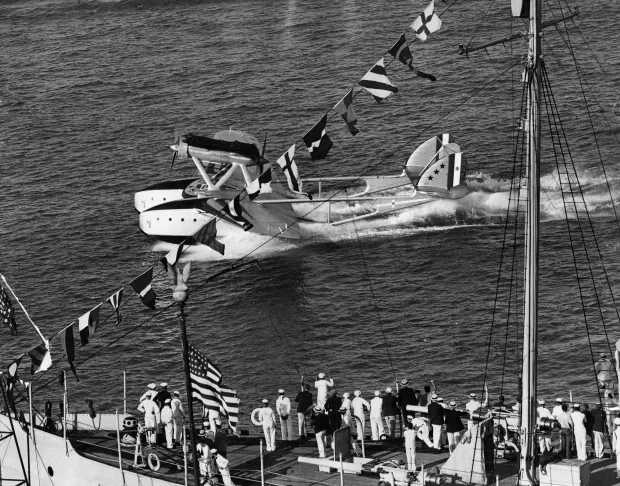
General Balbo and his crew splashed down on Lake Michigan at Navy Pier, just north of the Exposition site.
Right on target and right on cue.
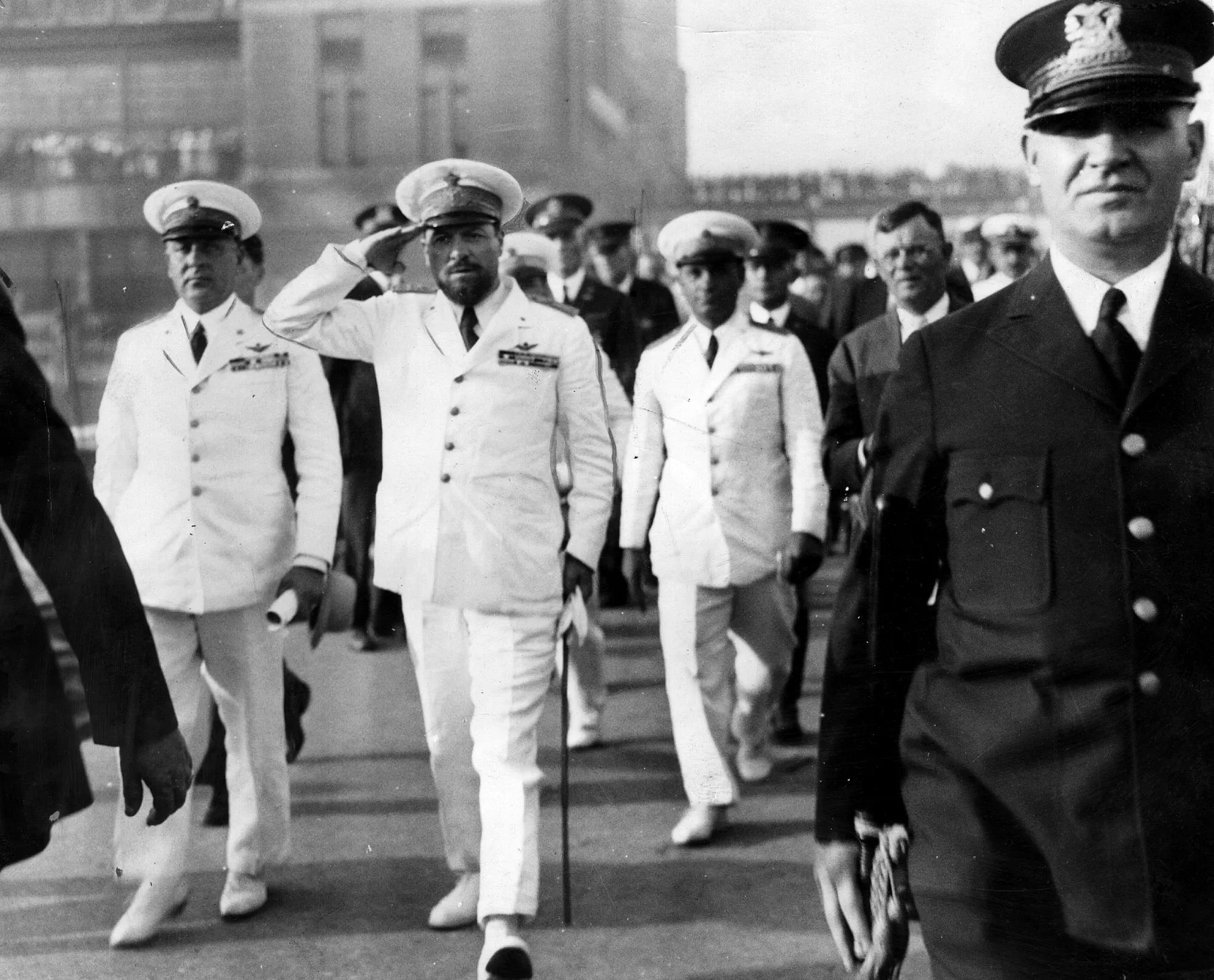
General Balbo and his flyers make an unfailingly stylish entrance.
(3) ITALO BALBO AND THE COLUMBUS THING
There was at least one gaping hole in Time Magazine's reporting. That journal does not mention Christopher Columbus, even once—unlike everyone else on the job.
Balbo as the Second Columbus was the chief story of the day. Journalists loved it, because it was so obvious and the copy seemed to write itself.
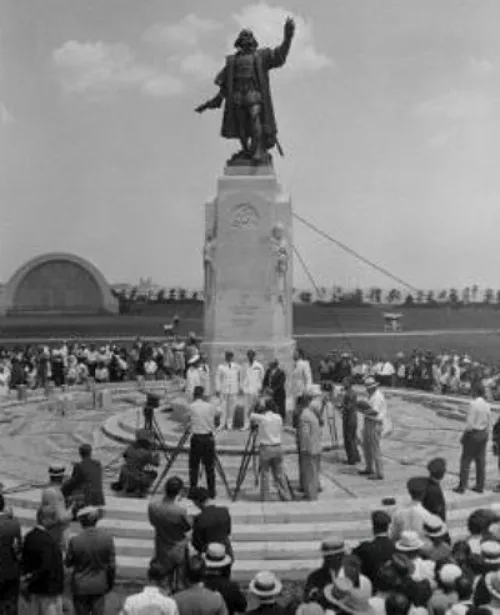
Balbo measured himself against the other Great Navigator as often as he could. On July 17. 1933, he engineered a mythic photo-op at the new Columbus Monument, recently installed in Grant Park near the Exposition.
A full-dress dedication came a few weeks later, after Balbo's departure for New York, Washington and ultimately Italy. This was the highlight of Italian Day at the Century of Progress.
On August 3, 1933, some 25,000 visitors—mostly Italian-Americans—packed out the Columbus ceremony. There was even an address by Benito Mussolini.
The initial plan was for the Duce to broadcast live from Rome by radio, but these arrangements fell apart (where was Marconi?) So the text was read by Ambassador Augusto Rosso who journeyed from Washington for the event.

Mussolini salutes "the dynamic city of Chicago":
“Chicago is inaugurating today, by initiative of the Italian community, a monument to Columbus…[who] sailed the oceans to discover a new continent. Italy, rejuvenated by Fascism, is happy to join in the celebration. Confident in the future, Italy future, Italy has sent through the skies the fleet of her aviators…”
The Duce left no box unchecked and his boldly-imaged message was replicated in every available medium.
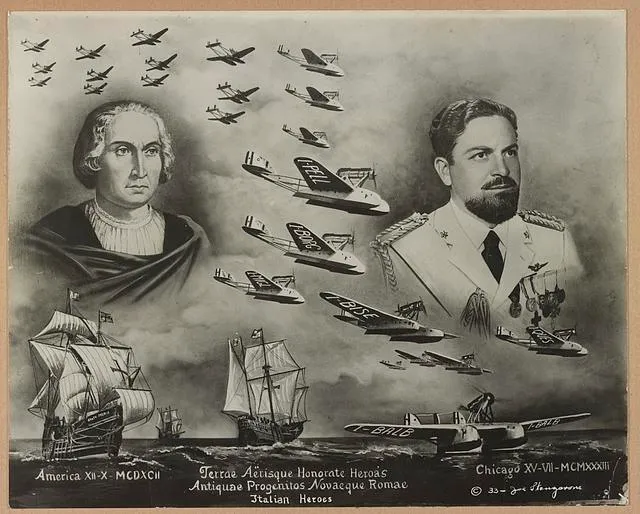
Christopher Columbus on the left, Italo Balbo on the right. Between them, Balbo's fleet of seaplanes lands on Lake Michigan, alongside the Niña, the Pinta and the Santa Maria.
This extravagant mash-up has an old-fashioned look. Even with the state-of-the-science amphibious vehicles, it evokes a nostalgic souvenir from a softly-focused past.
The Latin inscription seems to say it all:
Terrae Aërisque Honorate Heroa's Antiquae Progenitos Novaeque Romae
(The Earth and the Air Honor the Heroic Progeny of Ancient and New Rome)
Then there are the dates, one enshrined in popular history and the other as recent as yesterday:
XII-X-MCDXCII...12 October 1492...Columbus' Landing
XV-VII-MCMXXXIII...15 July 1933...Balbo's Landing
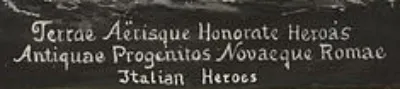
A host of questions come to mnd...
Why a Latin inscription?
Why the Roman numerals?
Why only two words of English: Italian Heroes?
Who is the "Progeny of Ancient and New Rome"?
What do they share with Mussolini's "Italy Rejuvenated by Fascism"?
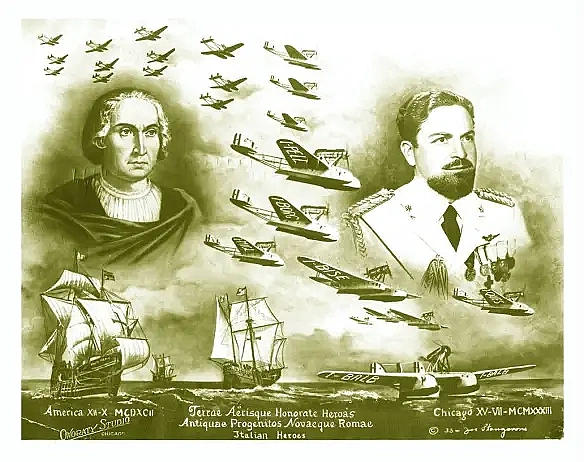
Historical evidence abounds —but what does it mean?
This particular item evidently exists in two versions: a print and a postcard. (I have not seen the originals.)
It was produced in Chicago in 1933, by Joe Stangarone.
Joe— not Joseph or even Giuseppe. An eagerly assimilating neo-American, it would seem.
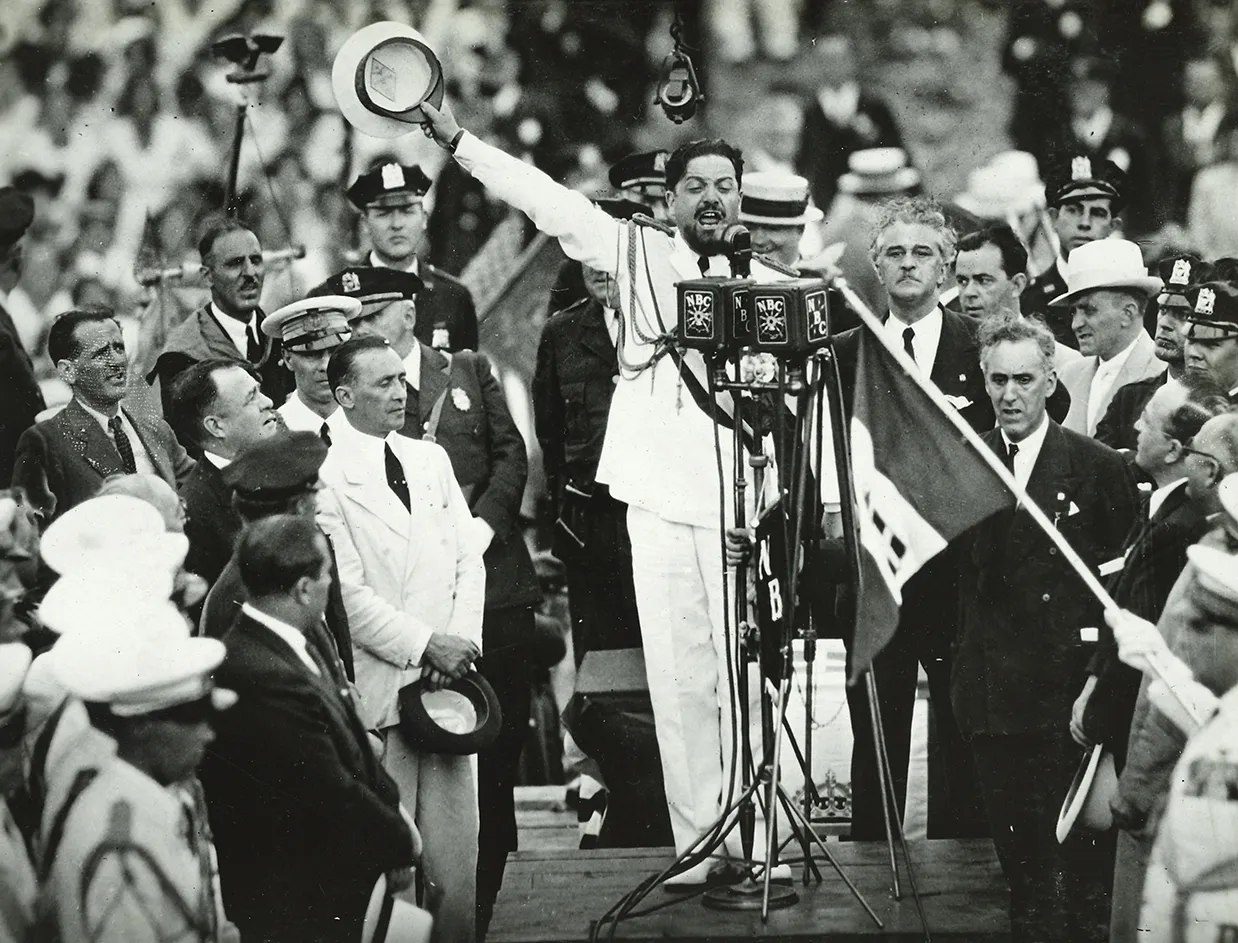
Italo Balbo addresses a massive Italian-American gathering at the Madison Square Garden Bowl and a broader radio audience.
Few could work a crowd, especially an Italian-American crowd, like Italo Balbo.
He spoke in Italian on behalf of an empowered Fascist Regime, broadcasting a message of ethnic pride, innate strength and bold self-reliance —uttering words that his listeners were unlikely to hear anywhere else.
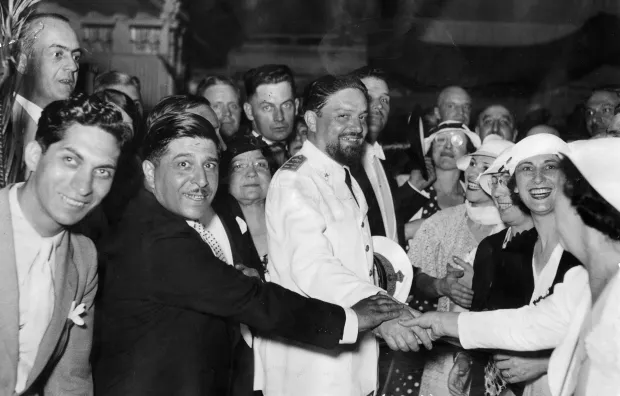
General Balbo does his magic...
All of that was nearly a century ago: Chicago's sensational Exposition... Italy's attention-grabbing pavilion... General Balbo's epic flight...
Only in later years did people begin to wonder about more or less everything —with the usual 20/20 hindsight.
Wasn't Italy a totalitarian state, our destined enemy in an imminent world war? How did they pull off a momentous publicity stunt in the very heart of our country?
How about Mussolini, Marconi, Balbo... and who else? What exactly were they doing and why?
How about the American organizers of the Exposition? Why didn't they see what we see today?
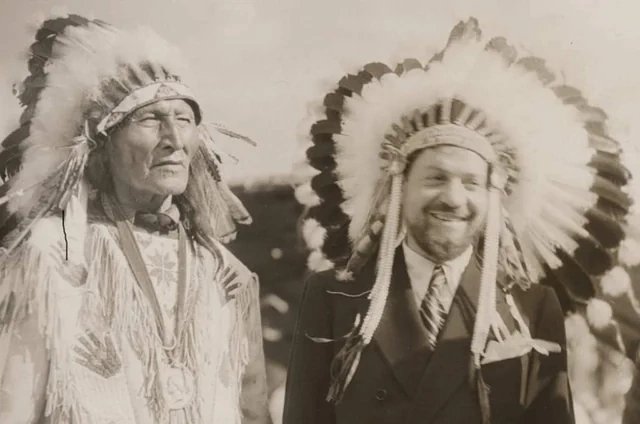
Every time we turn around, there are more unanswered questions.
So we can only keep moving —and we will see what we will see.
(4) MY HERO!

Marie Read Smith, an undergraduate at Barnard College, visited Italy in 1938 with a scholarship from Columbia University's philofascist Casa Italiana. That was the time of the anti-Jewish "Racial Laws", when Mussolini was falling into line with Hitler's more extreme policies. Smith was already a Duce enthusiast, so meeting him in person was a defining experience.
In Chicago— and across America— a broad swathe of the public was saluting the Duce, who was both a charismatic leader and an international celebrity.
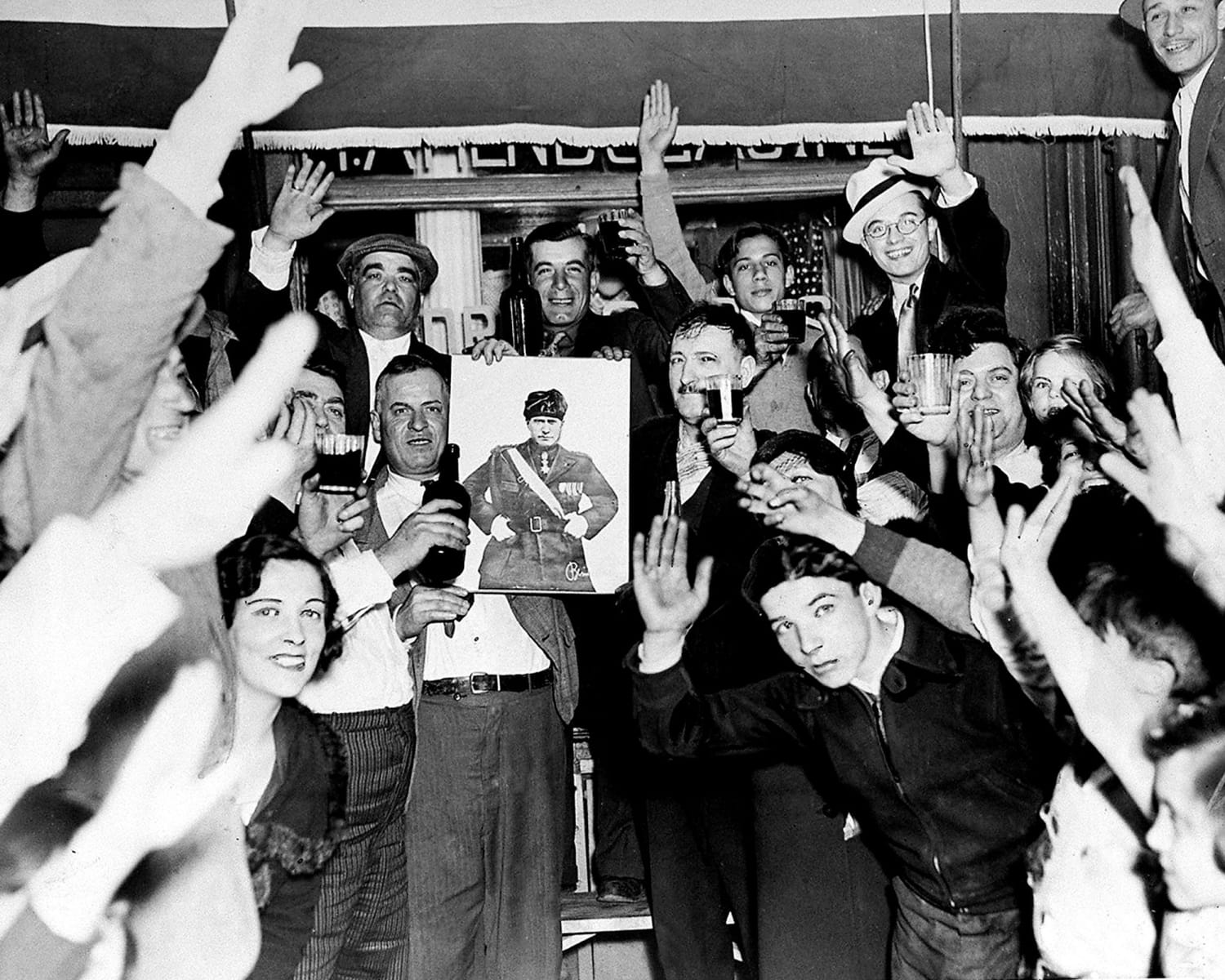
"UNITED STATES - MAY 06: Italians celebrate Mussolini's victory in Addis Ababa. New York's "Little Italy" went wild with joy over entry of Il Duce's troops into Addis Ababa. This group in front of 115 Mott Street drinks toast to Mussolini and to victory." (Photo by NY Daily News Archive)
Fascism (including Fascism Lite) was not strictly an Italian-American phenomenon, so Mussolini's admirers had plenty of sources nearer than the Old Country.
The Duce's transatlantic fan-base included political heavy-weights, civic officials, captains of industry and the brightest beacons of American popular culture.
Hollywood stars, that is to say...

"The Fascisti salute. Mary and Doug learned it in Italy from Mussolini. There is nothing like going to an authority! And now with their camping party they greet visitors at their beach camp in true Italian style."
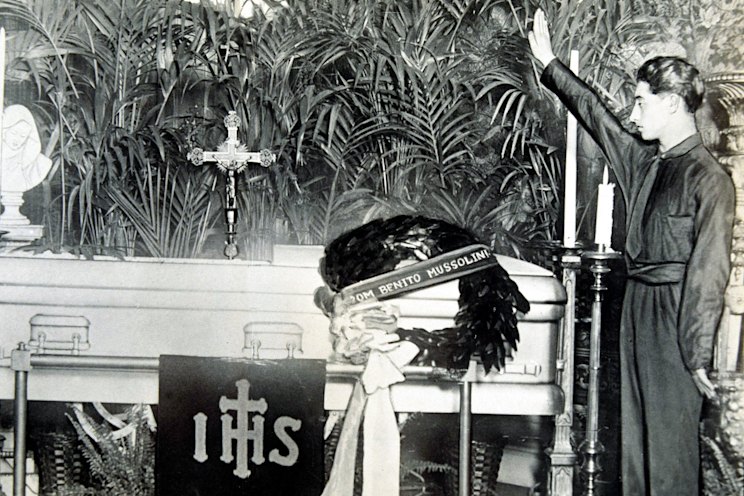

It is not clear that Rudolph Valentino was a supporter of Italian Fascism nor that Benito Mussolini ordered the personalized wreath and honor guard.
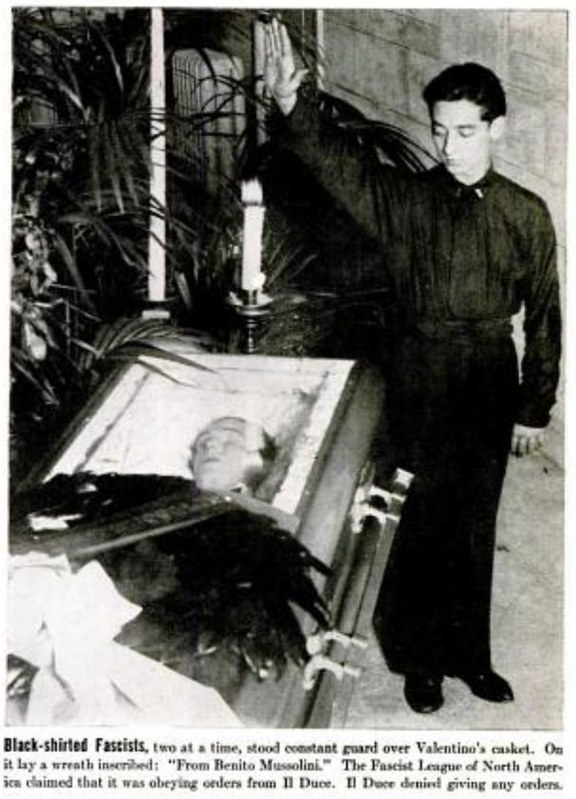

"Black-shirted Fascists, two at a time, stood constant guard over Valentino's casket. On it lay a wreath inscribed: 'From Benito Mussolini.' The Fascist League of North America claimed that it was obeying orders from Il Duce. Il Duce denied giving any orders."
FOR MORE ON THIS COMPLICATED STORY, SEE:
MUSSOLINI IN AMERICA
Fascism was an ideology for some, an ethnic creed for others, an opportunity for many and the fad of the moment for many more.
What it wasn't was "problematic" —for milions of Americans at least.

Italy's decade of Fascist Progress was right on target for the Chicago Exposition, but what sort of "Progress" did the American organizers have in mind?
Good old boosterism for sure, but what else? The above poster, announcing the grand opening on June 1, 1933, is not subtle in its imagery.
In a mere hundred years, Chicago has progressed from quaint primitivism (exemplified by an Indian Chief...literally red) to modern American civility (exemplified by a radiant young Greco-Roman woman with more than a hint of the Gibson Girl about her).

A distinctly Hellenic youth is separated from an ultra-Semitic Mesopotamian and an African tribal woman by a brawny arm wielding a Roman sword.
In the racialist publications of that time, juxtapositions of this sort were standard fare.
That included Italy's own La Difesa della Razza (The Defense of the Race), which focused on the intersection of "Science", "Documentation" and "Polemic" (with a decided preference for the latter).
The Mussolini Regime launched this new journal in August of 1938, setting the stage for its infamous Leggi Razziali (Racial Laws) the very next month

"I WILL" is the unofficial motto of the city of Chicago. (The official one, "URBS IN ORTO" —"City in a Garden" —evidently made sense in 1837 to early settlers who had never wandered amidst skyscrapers in winter.)

Both the "I Will Maiden" (as she is known) and her motto emerged from public contests in the lead-up to the 1893 Columbian Exposition. As specified, a phoenix rises from her crown, proclaiming the city's rebirth after the Great Fire of 1871.
George Petty rejected the usual plump and sedentary phoenix, substituting a more charismatic eagle surrounded by flames. This offers a striking counterpoint to the chieftan's eagle-feather headdress.
His "I Will Maiden" beckons us to the Exposition with an excruciating pun, "I WILL... COME!" Yet, it is never easy to take George Brown Petty seriously.

George Petty, creator of "The Petty Girl", is best known for his playful pin-ups in Esquire Magazine, his jazzy posters for the Ziegfeld Follies and his provocative advertisements more or less everywhere.
If Petty's Century of Progress poster were an animated cartoon, the marble goddess might crack a flirtatious smile in the next frame and give her sales pitch a risqué twist.

We have a fair idea of what "I WILL" meant in Chicago in 1893 —a commitment to persevere and prosper —but how about 40 years years later and farther afield?

Without positing a direct connection, we can consider Petty's conjunction of text and image in the political and visual culture of the 1930s —for those fascistically inclined.
In Germany, the concept of WILLE ("Will") had been accruing meanings —and we might say ideological baggage— ever since the first publication of Arthur Schopenhauer's philosophical masterwork Die Welt als Wille und Vorstellung (The World as Will and Representation) in 1818.

Schopenhauer conceived "Will" as the inexorable if unseen driving force behind reality. Composer Richard Wagner embraced this metaphysical concept and made it the driving force of his art.
Music, Wagner proposed, was the unmediated expression of "Will". In his operas, "Will" propelled the characters and determined their actions, with sacrifice, redemption and transcendance the essential themes.
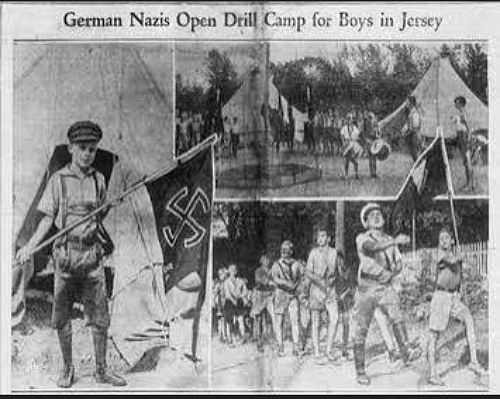

In Nazi-Fascist circles, "Will" propelled national self-determination— which was essentially racial and inherent in the bloodline of a people.
In the summer of 1934, the German American Bund (operating as The League of Friends of the New Germany) opened Camp Wille und Macht ("Camp Will and Might") in New Jersey, their first youth indoctrination center.
Their core message was simply expressed: True Americanism presumed Aryan dominance and "Will" was the key.

Slogans and mottos are slippery things, however decisive they seem at first glance.
But "Man Conforms"??? When it comes to "progress" as social determinism in the totalitarian mode, it is hard to beat the Chicago Exposition's ubiquitous tagline.
Why not "Man Utilizes"? Why not "Man Benefits"? Why not "Man Optimizes"?
If we are tempted to play fast and loose with the language of another time...
Related posts
COLUMBUS, MARCONI, BALBO AND MUSSOLINI: Italian Heroes Collide in Chicago - Part 2
At Chicago's 1933-34 Century of Progress Exposition, Guglielmo Marconi, the inventor of the radiotelegraph and Italo Balbo, the aeronautical “Second Columbus” led a brilliantly orchestrated public relations campaign on behalf of Benito Mussolini’s regime.
Fascist Italy commanded a dazzling array of scientific, technological and cultural resources. It channeled them all into a sensational spectacle that astonished, intrigued and outraged the American public.
(5) The Italian Pavilion (Chicago)
(6) The Other Exposition (Rome)
(7) The Commissioner Prince
(8) Two Directors and a Diplomat
COLUMBUS, MARCONI, BALBO AND MUSSOLINI: Italian Heroes Collide in Chicago - Part 3
At Chicago's 1933-34 Century of Progress Exposition, Guglielmo Marconi, the inventor of the radiotelegraph and Italo Balbo, the aeronautical “Second Columbus” led a brilliantly orchestrated public relations campaign on behalf of Benito Mussolini’s regime.
Fascist Italy commanded a dazzling array of scientific, technological and cultural resources. It channeled them all into a sensational spectacle that astonished, intrigued and outraged the American public.
(9) Behind the Scenes at the Italian Pavilion
(10) On Message and Off
WORK IN PROGRESS
COLUMBUS, MARCONI, BALBO AND MUSSOLINI: Italian Heroes Collide in Chicago - Part 4
At Chicago's 1933-34 Century of Progress Exposition, Guglielmo Marconi, the inventor of the radiotelegraph and Italo Balbo, the aeronautical “Second Columbus” led a brilliantly orchestrated public relations campaign on behalf of Benito Mussolini’s regime.
Fascist Italy commanded a dazzling array of scientific, technological and cultural resources. It channeled them all into a sensational spectacle that astonished, intrigued and outraged the American public.
(11) The Second Columbus Crashes and Burns
WORK IN PROGRESS

GUGLIELMO MARCONI: Science, Fascism, Antisemitism and What Else?
History has given a free pass to Guglielmo Marconi, who was both a scientific genius and a Fascist ideologue.
There are two stories to tell—first in Italy and then in America.
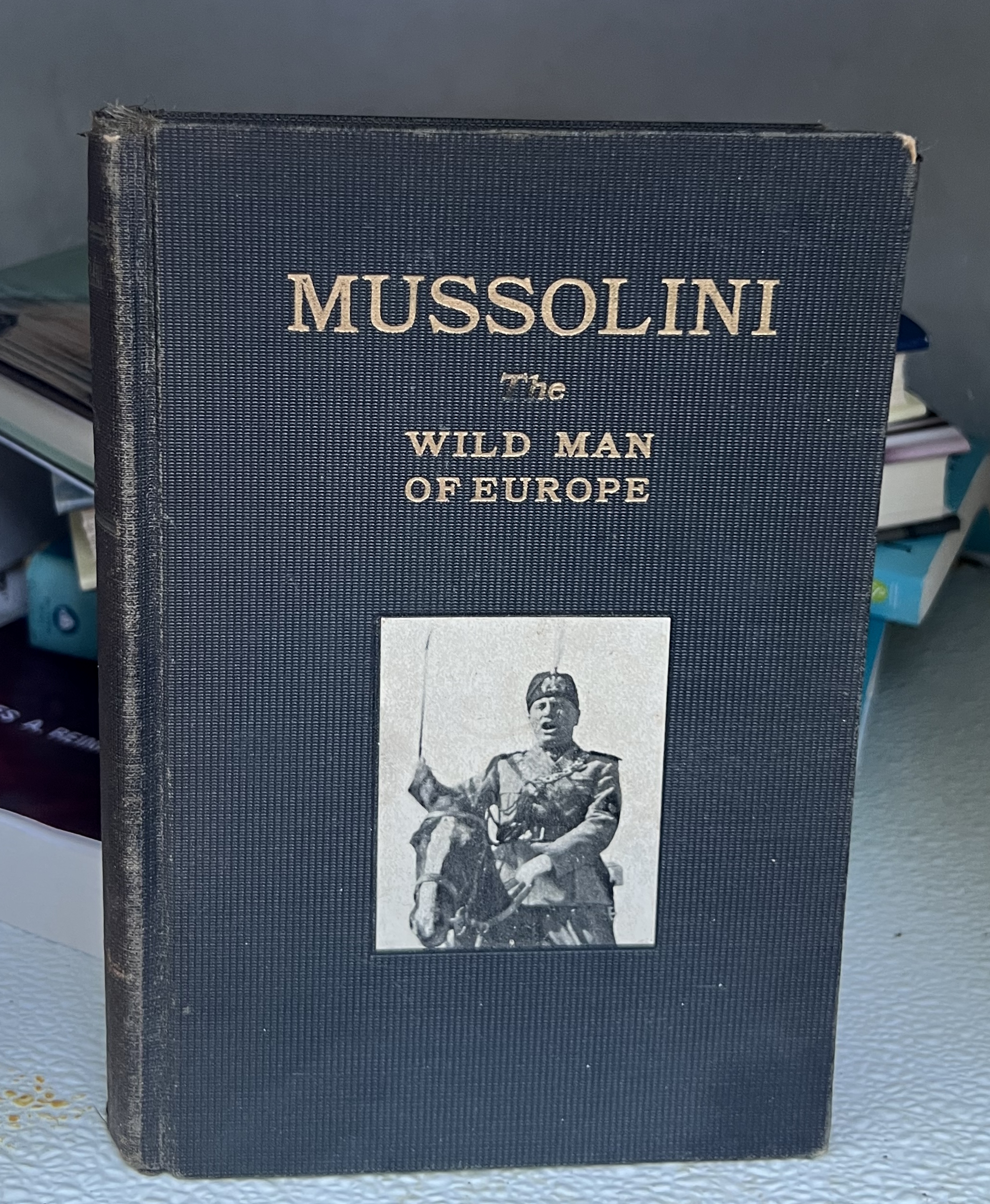
MUSSOLINI: THE WILD MAN OF EUROPE - Part 1
In a "Little Library" in Washington DC, I happened upon "Mussolini: The Wild Man of Europe"— John Bond's eccentric exposé of Benito Mussolini, printed in the Nation's Capital in 1929.
In my first post, "Wild Man, Part 1", Bond helped reveal the inner workings of the Ku Klux Klan in Washington DC, Atlanta GA and Altoona PA.
In "Wild Man, Part 2", we took Bond's book to Fascist Italy and viewed the Duce through the outraged author's eyes.
Here in "Wild Man", Part 3", we bring Bond back to Philo-Fascist America. There we see the Duce lauded by Italian Americans, by Hollywood celebrities and by the mainstream press.
Who was John Bond? A "Militant Freemason", a virulent anti-Catholic and an anti-Mussolini conspiracy theorist.
How about his message? Bond was strange and obsessed but he wasn't always wrong.
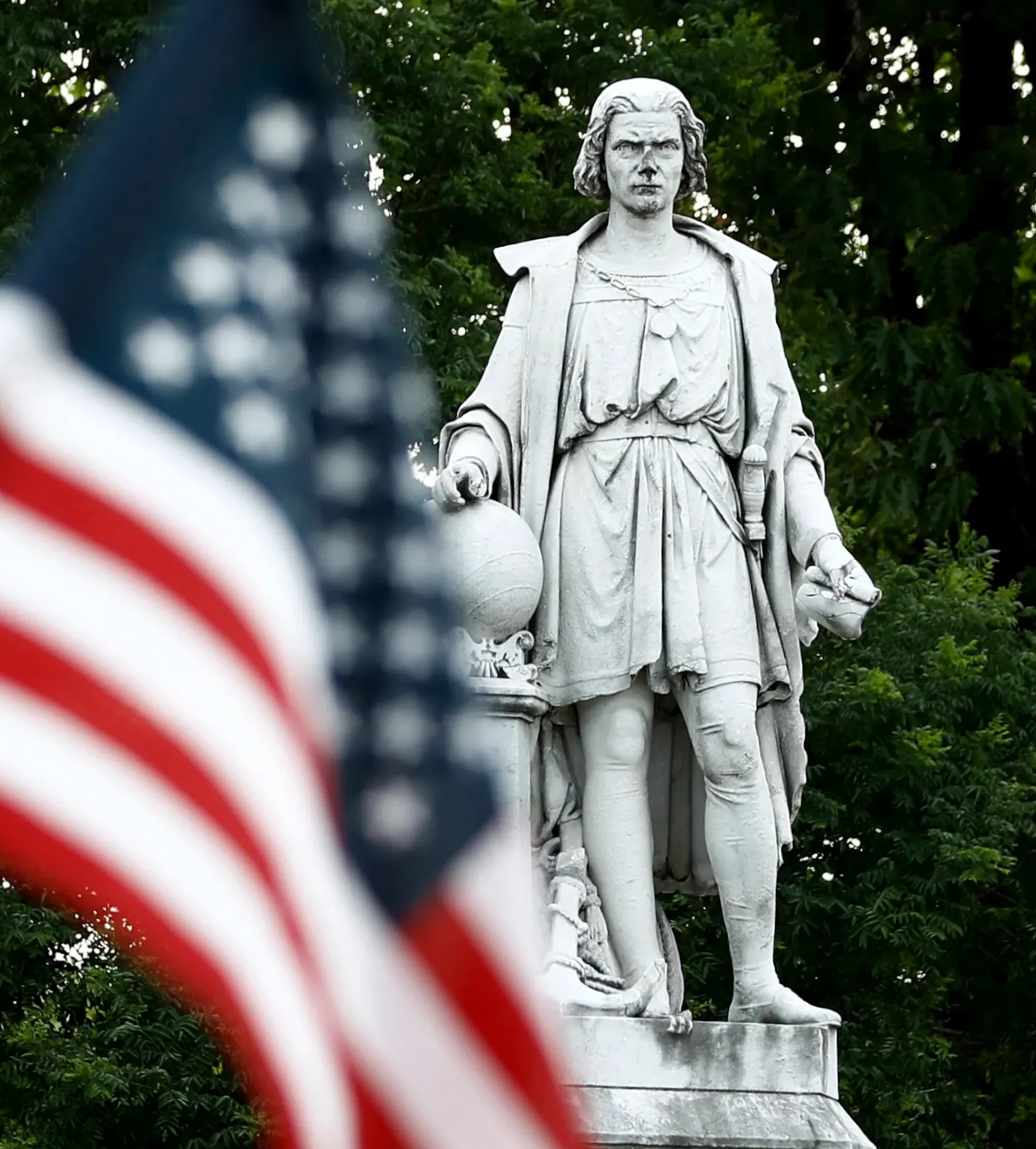
WHOSE COLUMBUS? WHOSE COLUMBUS DAY? Part 1: It begins with a statue in Philadelphia in 1876
Why is Columbus Day the most controversial of American holidays?
People disagree —often violently —about its past and present meaning.
Here are the facts. Make of them what you will!
***
The story begins in South Philly (then and now) and takes us to the American Civil War and the 1876 Centennial Exposition.
We meet Christopher Columbus (in several incarnations), sculptor Emanuele Caroni and Nunzio Finelli (ideator of Philadelphia’s Columbus Statue, long in Fairmount Park, now in Marconi Plaza).
Lorem ipsum dolor sit amet, consectetur adipiscing elit. Suspendisse varius enim in eros elementum tristique. Duis cursus, mi quis viverra ornare, eros dolor interdum nulla, ut commodo diam libero vitae erat. Aenean faucibus nibh et justo cursus id rutrum lorem imperdiet. Nunc ut sem vitae risus tristique posuere.