COLUMBUS, MARCONI, BALBO AND MUSSOLINI: Italian Heroes Collide with American Reality - Part 2
CONTENTS:
(5) THE ITALIAN PAVILION (CHICAGO)
(6) THE OTHER EXPOSITION (ROME)
(7) BEHIND THE SCENES AT THE ITALIAN PAVILION (CHICAGO)
(8) THE SECOND COLUMBUS CRASHES AND BURNS
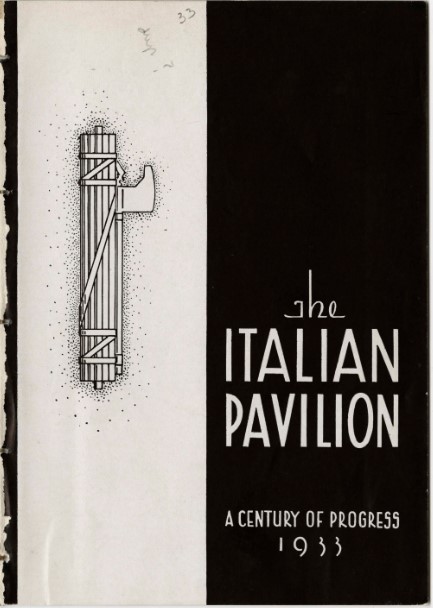
FOR A FULL SCAN OF THIS PAMPHLET, SEE:
THE ITALIAN PAVILION: A CENTURY OF PROGRESS, 1933
(5) THE ITALIAN PAVILION (CHICAGO)
What we see is what we get— with a rampant fasces on the cover...

“Italy, as you no doubt know, has a more significant background than any country of the western world… With this thought in mind, the Italian Pavilion was planned to tell the story of Italy to the World’s Fair Visitor. In the Pavilion you will find vestiges of ancient Rome, the splendor of Renaissance Italy and the history making progress of modern Italy, through the period of unification; the World War and under the masterful leadership of Premier Mussolini.”

Italy Old and Italy New... in the central space of their pavilion.
In color, the concept is immediately clear —especially the unsubtle color of a 1933 postcard.
On the lower level, we admire "transparent photographs" (a technological innovation) of Ancient Roman sites, on softly back-lit panels, in atmospheric monochrome.
Above, we are assaulted by boldly-hued modern forms, proclaiming the Manifest Destiny of the Fascist State.

Mussolini’s head (in bronze) supports the fasces while its blade emerges to the right. DUX = Duce. ROMA CAPUT MUNDI = Rome Capital of the World. XI = 1933 (Year Eleven of the Fascist Era).
Who is our infallible guide to Italy's present-day reality?
Do we even need to ask?!
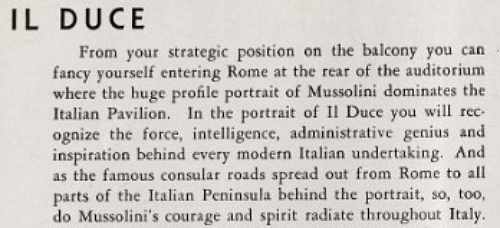
"IL DUCE: From your strategic position on the balcony you can fancy yourself entering Rome at the rear of the auditorium where the huge profile portrait of Mussolini dominates the Italian Pavilion. In the Portrait of Il Duce you will recognize the force, intelligence, administrative genius and inspiration behind every modern Italian undertaking. And as the famous consular roads spread out from Rome to all parts of the Italian Peninsula behind the portrait, so, too, do Mussolini’s courage and spirit radiate throughout Italy."
As for the various fasces... there and throughout the pavilion:
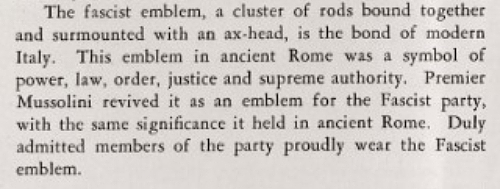
"The fascist emblem, a cluster of rods bound together and surmounted with an ax-head, is the bond of modern Italy. This emblem in ancient Rome was a symbol of power, law, order, justice and supreme authority. Premier Mussolini revived it as an emblem for the Fascist party, with the same significance it held in ancient Rome. Duly admitted members of the party proudly wear the Fascist emblem."
The guidebook then shuffles us through the actually rather small pavilion, disclosing a mash-up of things and more things —while striking the conjoined chords of “Progress” and “Benito Mussolini”.
Roman roads and modern highways... Yesterday's triremes and today's luxury liners... Marvels of electronic science from Volta to Marconi... Agricultural innovation, land reclamation and soaring rates of food production.

“MERCHANTS: In the lobby at the entrance to the main floor of the Italian Pavilion and in the north and south wings, you will find native Italian merchants displaying for sale dozens of lines of merchandise. It will pay you to visit these shops as they offer you many souvenirs as well as practical and worth-while gifts. All merchandise has been brought from Italy and the Italian colonies.”
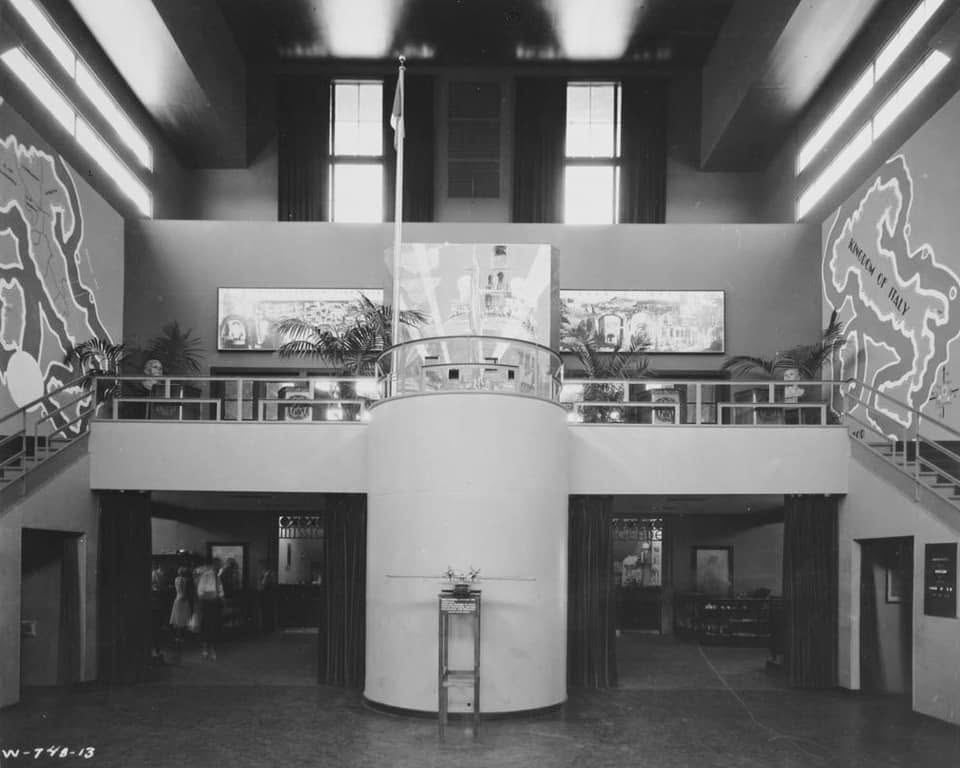
Then there was stuff to buy and lots of it— in your face as soon as you walked in the door.
All from "native Italian merchants", whatever that might mean.

Not this, in any case... which for some would have come immediately to mind.

Instead, we find "jewelry, mosaics, and carpets from Florence", "beautiful glassware from Murano and other provinces", "Truscan-Pompey (sic) pottery", "marble statuary, rare linens and embroidery from Naples and Rome", "artware, ivory and perfumes from Tripoli", "antique brocades from Pisa", "a wealth of paintings, tapestries, rugs, carved wooden figures, leatherware, Italian tobacco, and olive oils from Florence, Rome and Venice".


Viewed from the Avenue of Flags, the Exposition’s chief artery, the Italians upstaged every other National Pavilion in sight.
For the organizers, the architectural message was simple and clear.

THE ITALIAN PAVILION: Now before you leave the grounds of the Italian Building, may we ask you to pause for a moment to study the exterior of the building. The structure was designed by M. Derenzi, A. Valente and A. Libera of Rome as a monument to Italian progress in aviation and as a symbol of the flight of General Italo Balbo, who led an armada of seaplanes from Italy to A Century of Progress Exposition.

ITALIA + Stylized Fasces (with illuminated blade) + Airplane Wing
Quoting the official guidebook, "General Italo Balbo... led an armada of seaplanes from Italy to A Century of Progress Exposition".
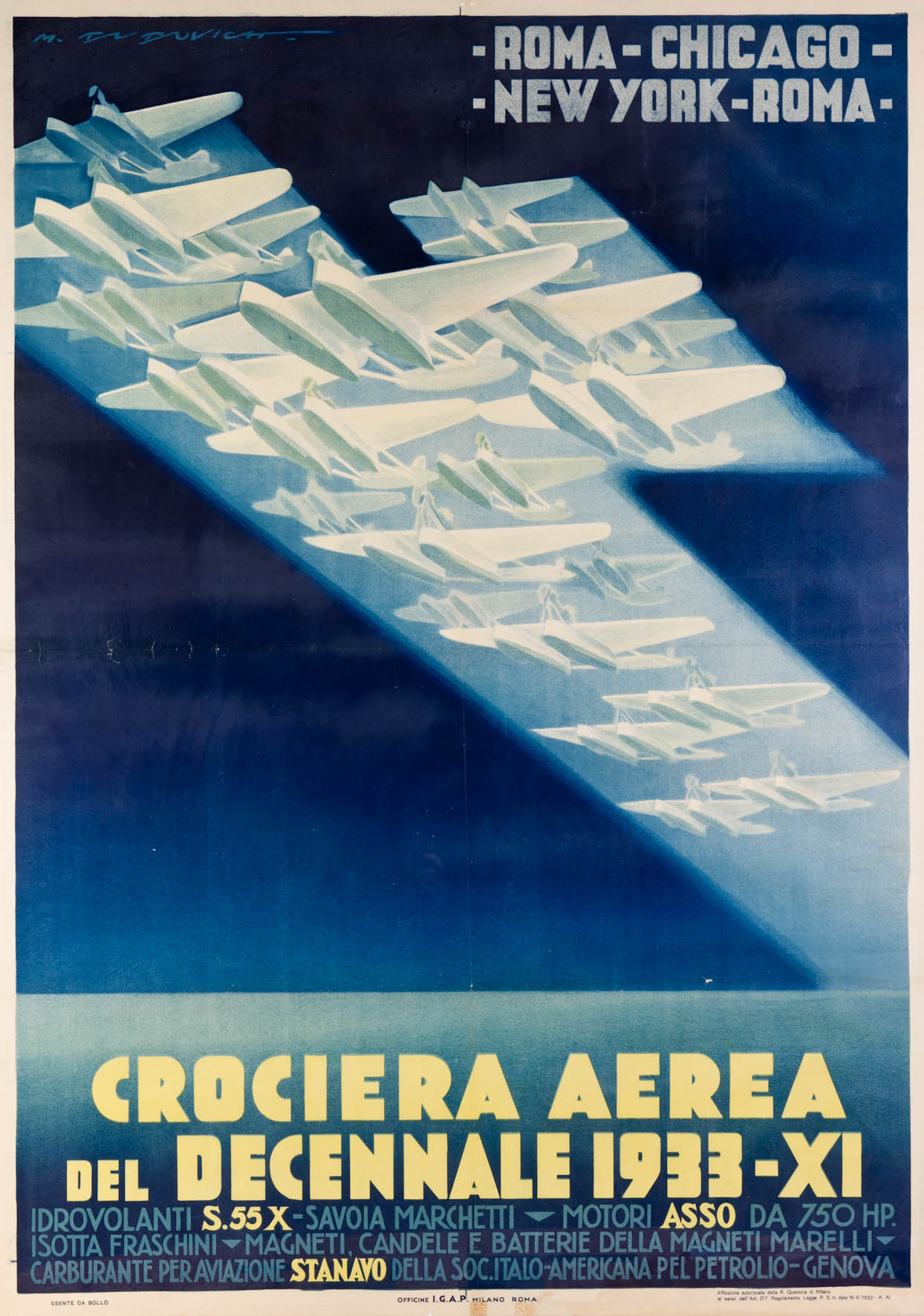
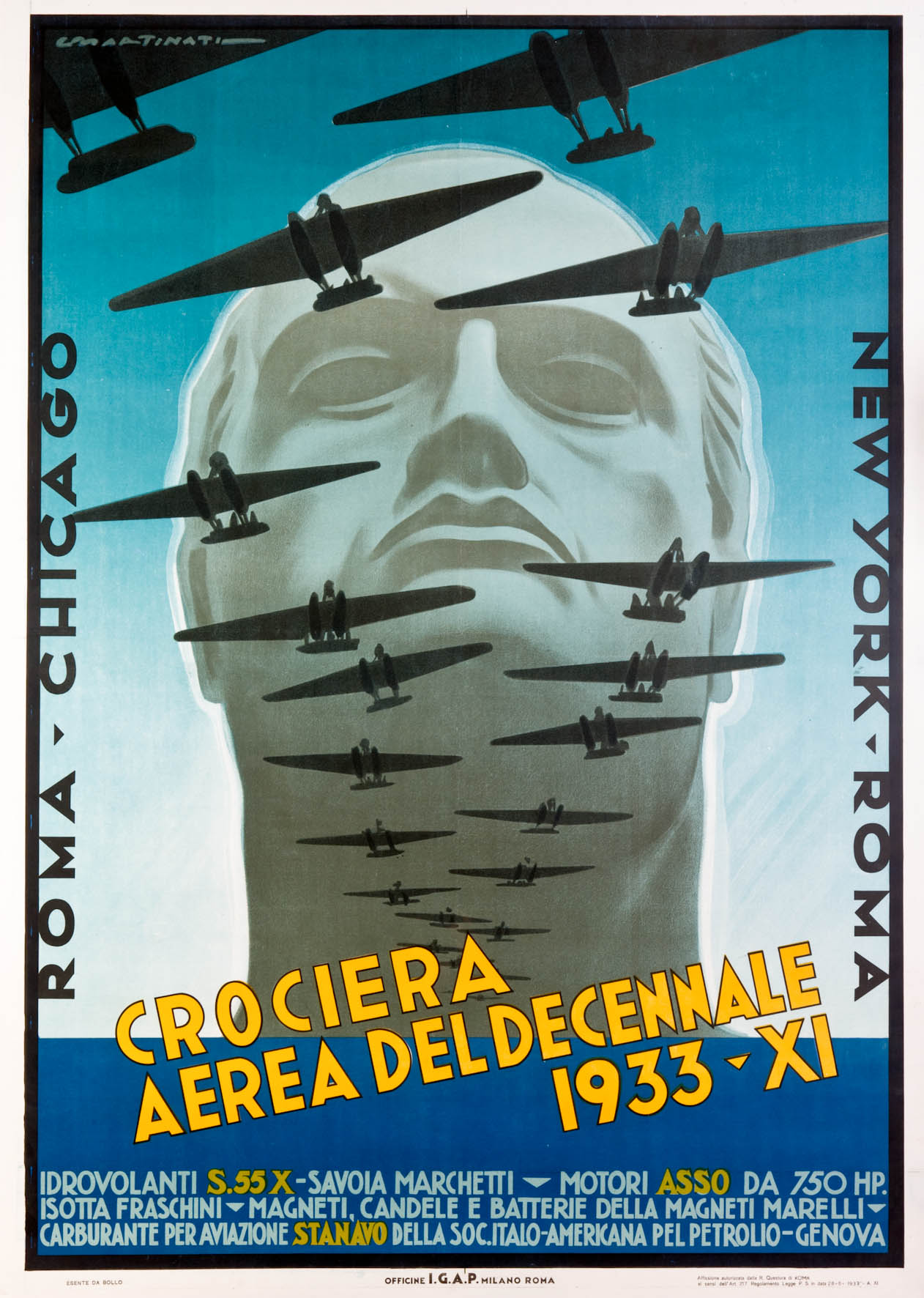
To mark the 10th annivesary of the Mussolini revolution, a flying fasces wings its way across the Atlantic —from Rome to Chicago to New York to Rome (although Balbo's actual point of departure and return was Orbetello on the Tuscan Coast).
"Armada"? Not "Fleet", "Squadron" or "Company"?
An armed incursion? A show of force at very least?
All in the name of the DECENNALE —although the first Fascist Decade was now running over from YEAR X to YEAR XI.
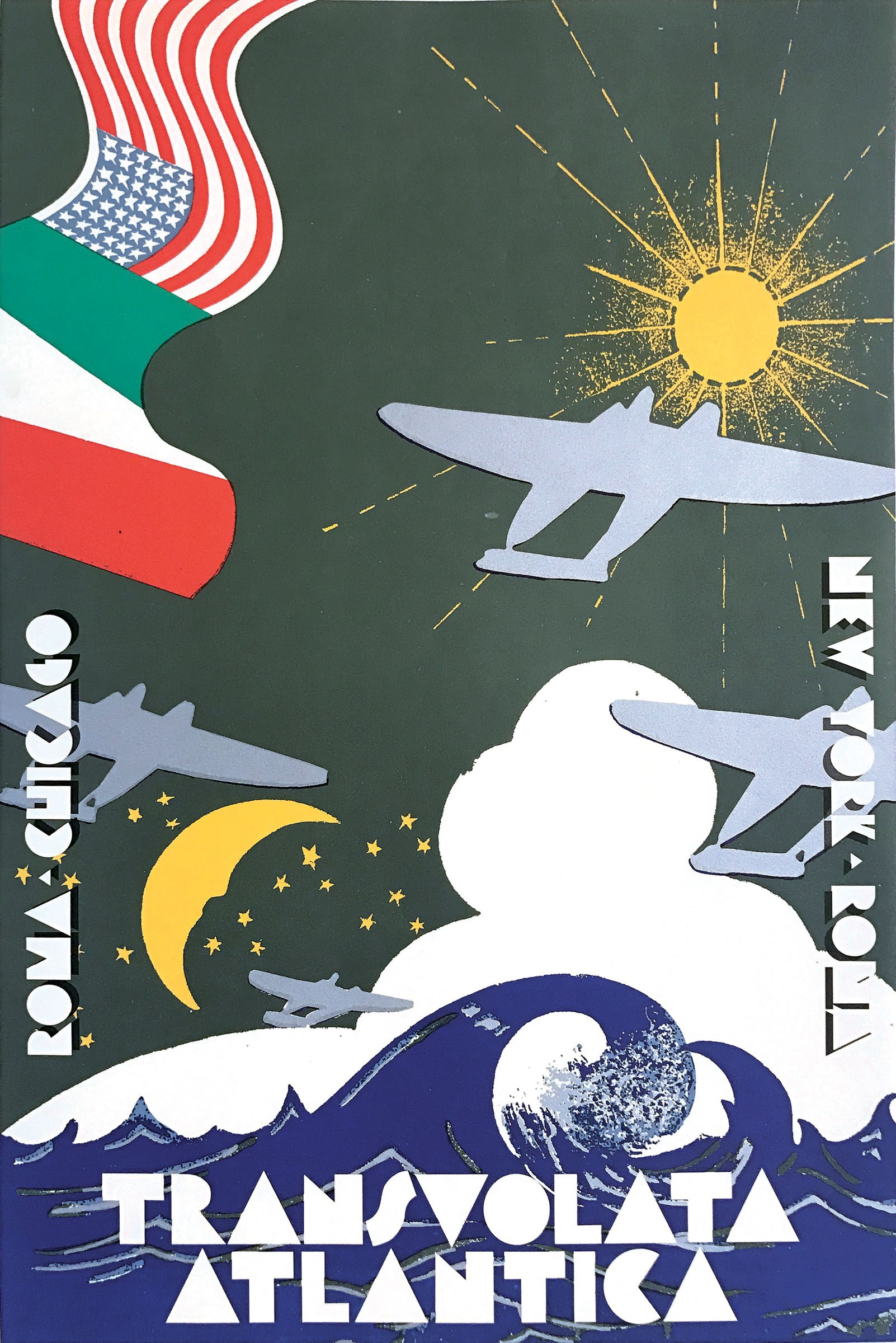
A rotund Duce emerges from the clouds in a whimsical rendering that alludes both to folk art and children's story books.
There was an onslaught of more or less martial images of this kind, directed primarily at the Italian public it would seem.
Meanwhile —for Americans at the Century of Progress Exposition —the Italian organizers tried a softer approach.
General Balbo, renowned fighter pilot and Minister of Aeronautical Defense, was now the jovial face of civil aviation.
He was the man who opened the skies of "Sunny Italy" to tourists and business travelers alike.

“Moving along on our tour of the Italian Pavilion we find maps outlining the aerial and road communication of Italy. To the modern Italian, aviation and progress are synonymous… Flying in ‘Sunny Italy’ has proved very popular… Airways in Italy are popular with the business man because they afford quick and reliable transportation over the mountainous country, while the traveler takes to the air to see the scenic splendor of Italy from a bird’s-eye view.”
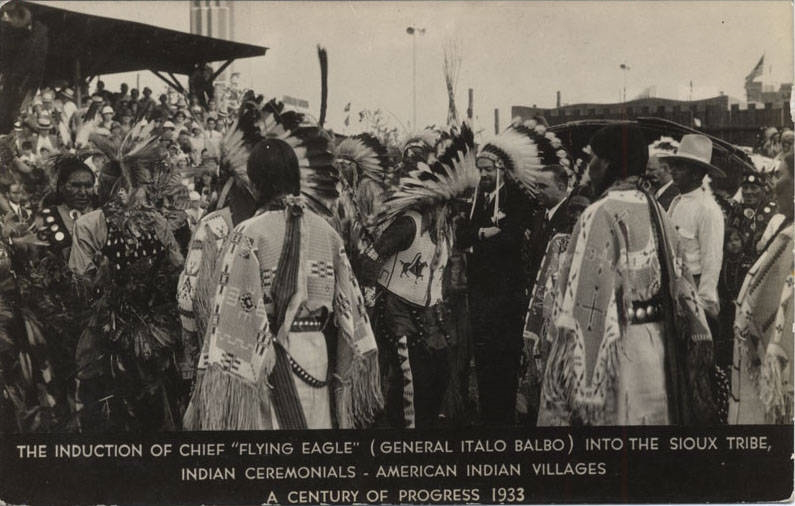

"The induction of Chief 'Flying Eagle' (General Italo Balbo) into the Sioux Tribe , Indian Ceremonials - American Indian Villages, A Century of Progress 1933"
Balbo was always the man of the moment, wherever he appeared, in whatever guise— and at the Century of Progress Exposition, the sky was the limit it seemed.
(6) THE OTHER EXPOSITION (ROME)
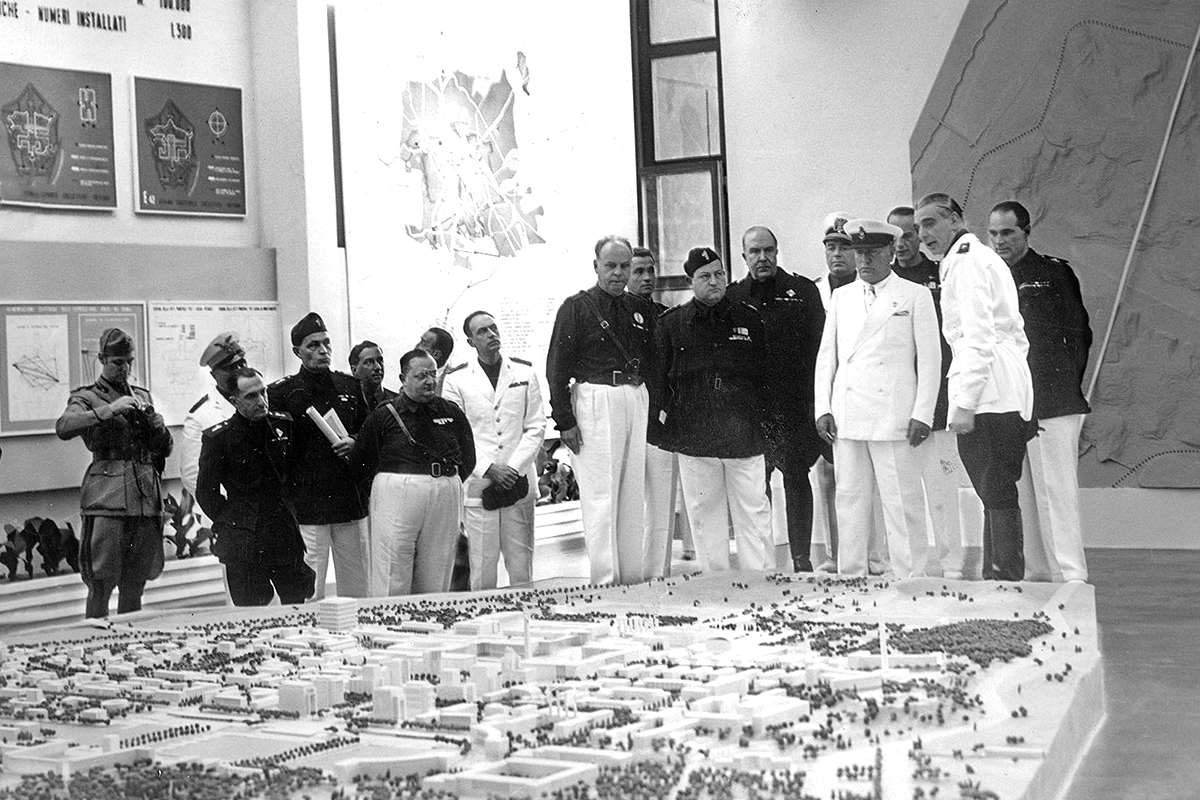
The balding figure in black shirt and white trousers, framed by the right edge of the EUR plan, is architect Marcello Piacentini —Mussolini's chief supervisor of building projects. The 1942 World's Fair was planned to mark the 20th Anniversary of the Fascist Revoluton.
FOR MORE ON ROME'S EUR QUARTER, SEE:
E.42: MUSSOLINI'S FASCIST THEME PARK ON THE OUTSKIRTS OF ROME
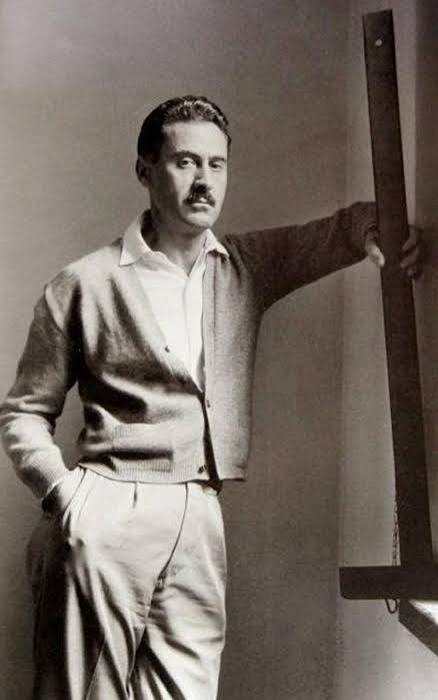
Adalberto Libera...

Mario Derenzi...

Antonio Valente...
According to the official guidebook, the Chicago pavilion was designed by these three architects from Rome.
Not just from Rome, however, but from the very heart of the Fascist Regime —from the core of architects who were developing sites across Italy and the expanding Italian colonies.
In practical terms, Chicago figured on the same emerging project map as Addis Ababa, Asmara, Tirana and Tripoli, plus hundreds of localities in the homeland.

Italy's Century of Progress Pavilion in Chicago was an offshoot of the contemporary Decennale observances, marking the first Decennio Fascista (Fascist Decade) of 1922-1932.

"Italians and Foreigners at the Exposition of the Fascist Revolution": In over 700 pages, the author chronicles the four million vistors to the Roman exposition.
The main events were concentrated in Rome then promoted across Italy and abroad —with advertising in various languages plus travel discounts and package tours.

The chief focus was the great Exposition of the Fascist Revolution, installed in high regime style in the old Beaux Arts Palazzo delle Esposizioni in Via Nazionale.
Adalberto Libera designed the facade and entrance hall.
Mario Derenzi realized the monumental decorative elements (including the massive fasces and the "X" for "Year Ten").
Antonio Valente (best known as a theatrical designer) did other interior work.


In YEAR X of the Fascsist Era, they were giving tangible form to a recent but already mythic past.
When Mussolini's various architects rose to the occasion —which they did with stunning frequency— they achieved results unlike anyone else.
They brought top-notch design talent to any task, while accessing a national supply of quality materials and a skilled and numerous work force.

Monumental modernism, imbued with the Roman ethos of the Eternal City.


Bold historical narration powered by Futurist / Constructivist style.

We can entertain ourselves by imagining the reaction to the Century of Progress pavilion by knowledgeable Italians with first-hand experience of cultural developments back home.
What if they had also seen the Exposition in Rome, with its incessant drama and prevailing high style?
“Fa il suo effetto…” (“It delivers the required effect…”) regarding Chicago's aeronautical exterior.
“Bello, ma un po’ poco…” (“Nice, but underwhelming...”) regarding Chicago's oddly cosy interior.

Comfortable armchairs, a companionable sofa, a convenient ash tray.
Pleasant pictures of Italian regions... like the waiting room in an upscale tourist agency.
Or the parlor of a bourgeois patron with a penchant for Italy and moderately advanced tastes.

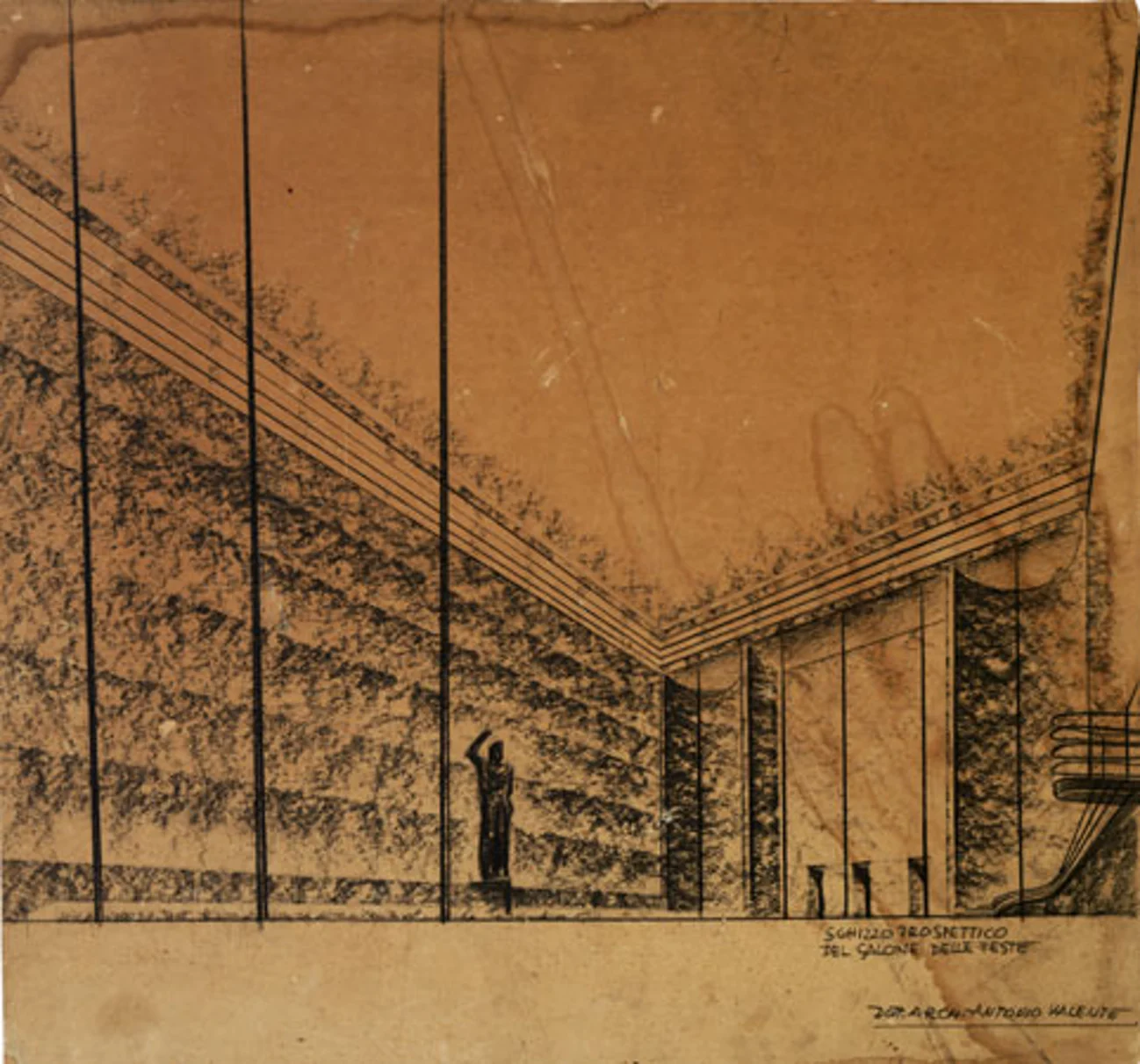
That was not what the architectural team had in mind for Chicago, at the outset at least.
Antonio Valente projected a Regime Space in all its glory, optimizing the grand verticality that defined the exterior of the buiilding.

“Architecture is the Art of the Possible”. That became a favorite concept of the brutalist master Paul Rudolph a decade or two later.
Rudolph was thinking primarily of materials and construction —but when it came to getting things built, nuts and bolts were not always the crux of the problem.


The Italian Royal Arms look rather old-fashioned next to the futuristic Century of Progress logo. However, this version —with double fasces supporting the crowned Cross of Savoy —was a recent update, in use only from 1929 to 1944.
(7) BEHIND THE SCENES AT THE ITALIAN PAVILION (CHICAGO)
What names pop out at us from the official guidebook?
We already noted:
BENITO MUSSOLINI (DUCE)
ITALO BALBO (AIR FORCE GENERAL)
ADALBERTO LIBERA (ARCHITECT)
MARIO DERENZI (ARCHITECT)
ANTONIO VALENTE (ARCHITECT)
Now we can add:
PRINCE LUDOVICO POTENZIANI (ROYAL ITALIAN COMMISSIONER TO A CENTURY OF PROGRESS)
COMMANDER LUIGI RANIERI (GENERAL DIRECTOR OF ITALIAN PAVILION)
GIUSEPPE CASTRUCCIO (ROYAL ITALIAN CONSUL AT CHICAGO)
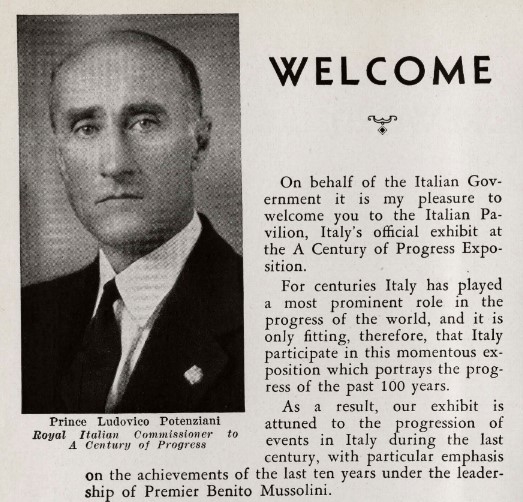
Ludovico Spada Veralli Potenziani, Royal Italian Commissioner to A Century of Progress.
"On behalf of the Italian Government it is my pleasure to welcome you to the Italian Pavilion...[O]ur exhibit is attuned to the progression of events in Italy during the last century, with particular emphasis on the achievements of the last ten years under the leadership of Premier Benito Mussolini."
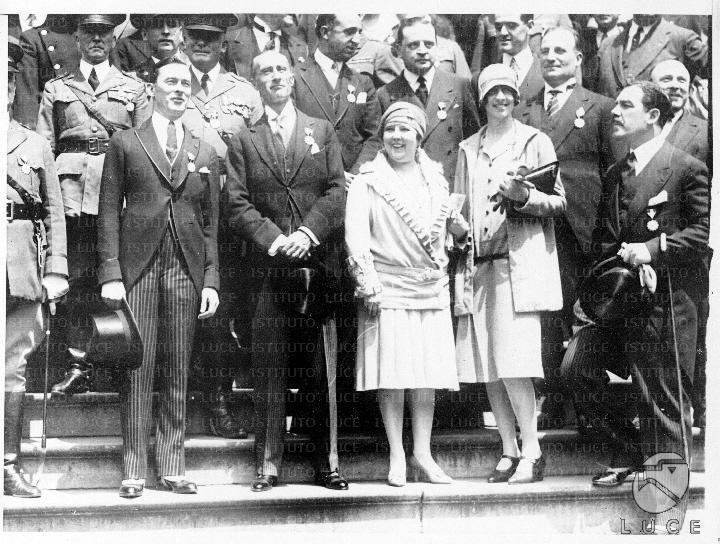
Ludovico Spada Veralli Potenziani (1880-1971), Fourth Prince of Castel Viscardo, was a notable figure in his time —cycling through an imposing array of offices and appointments.
In his early years, he demonstrated a particular interest in aviation, becoming president of the Società Aeronautica Italiana in 1908 and president of the Aero Club d'Italia in 1911. During World War I, he served as an officer in the Genio Aeronautico (the newly emerging military sector of Aeronautical Engineering).
Potenziani visited New York in the spring of 1928, where he was honored with a ticker-tape parade. At that time, he was Senator of the Kingdom of Italy and Governor of Rome (in effect, appointed mayor). Also a member of the Italian Fascist Party, needless to say.



ITALIANS HERE HONOR THE ROMAN GOVERNOR. Prince Ludovico Spada Potenziani —the “very distinguished and terribly likeable Governor of Rome,” as he was described by Mayor Walker —was the guest of honor at a dinner of the Italian Societies of New York at the Plaza last night”
“The Mayor promised the Prince that for all his high social and financial position that he had so captivated the people of the City of New York that to him he was “just one of the boys.” He praised him for having gone into the public service as so few persons of equivalent position in his country would have done.”
"Just one of the boys...?" Amerca's fetishization of European aristocracy meets the national cult of the "Regular Joe"?

“The Prince spoke of the rapid development of Italian prosperity under the Fascist régime; particularly the production of electrical energy, the development of the merchant marine and the reclamation of marsh land to agriculture. He denied that Italy is dominated by the Government which is imperialistic or tyrranical (sic) and closed by quoting the advice of Mussolini to Italian-Americans to obey the laws of their adopted country.”
"Rapid development of Italian prosperity under the Fascist régime..." offers an uncanny preview of the message of the yet unimagined Century of Progress pavilion.
"He denied that Italy is dominated by a Government which is imperialistic or tyrannical..." thereby acknowledging that others were saying exactly that.
Mussolini advised "Italian-Americans to obey the laws of their adoped country." Didn't that go without saying?

What was a "General Director"? Unlike the three emiment architects, he was on the ground in Chicago.
Project Director sent from Italy to oversee construction and installation


Additionally, Alexander V. Capraro (the first licensed Italian-American architect in Illinois) served as the associate and supervising architect in Chicago, while Comandante Luigi Ranieri acted as the architect and consulting engineer sent by the Italian government. [1, 2]
https://www.findagrave.com/memorial/186312817/alexander-v-capraro
https://blogginginitaly.com/2024/11/04/alexander-capraro-recognition-ceremony/
Luigi Ranieri Photographic Archive
Not a prince but evidently connected to the noble Ranieri family of Perugia
Citation of Marconi who was initially scoped out for Potenziani's Commissionership

Photo prominently featured but no explanation of his involvement


Ranieri far right
Castruccio third from left
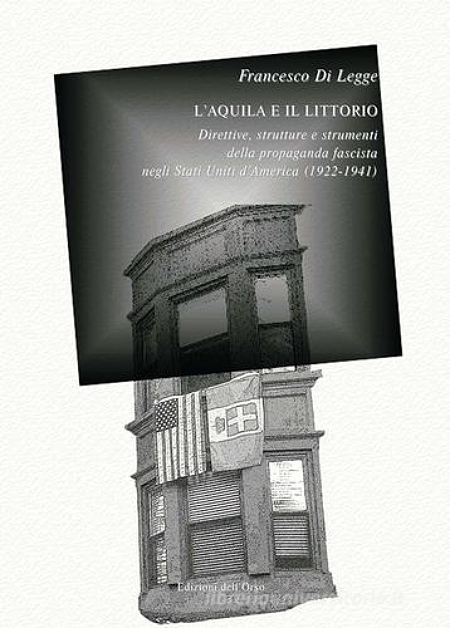
monumental study
clear-eyed and impeccably researched
accessing the voluminous documentation preserved in the archives of the Italian government

concise and meticulous reconstruction of the


Capraro not cited in the guidebook but evidently a well-known and well-remembered figure in the Italian community of Chicago--and the principal Italian American involved in the project.


Essentialness of aeronautics in the ideation of the Italian presence at the CoP.
(8) THE SECOND COLUMBUS CRASHES AND BURNS
Ultimately, Italo Balbo was too charismatic for his own good. Back in Italy, many saw him as the Duce's self-appointed successor and an overly-eager one at that.
Although Mussolini and Balbo had been political allies for as long as anyone could remember, essential differences were becoming harder to ignore.
According to Balbo, Germany was undermining Italian autonomy and obstructing Italian priorities —while an impotent Mussolini looked on.
Then there were the creeping excesses of Nazi racial policy, which the Duce was unable or unwilling to oppose.
Balbo was born and raised in Ferrara, amidst ardent Jewish fascists, and he maintained close relations with them until the very end.

Benito Mussolini visits Tripoli as Imperial overlord in 1937. Italo Balbo flanks him at a grand evening event, with the Duce in orientalizing fancy dress.
Rome was not big enough for both Mussolini and Balbo. Only a few months after his American triumph, the Duce shunted him off to Libya as Colonial Governor.
Mussolini also pulled the plug on Balbo's long-running media sweep. Italian newspapers —going forward —were ordered to feature him less frequently and in subordinate roles.
During the remaining six years of his life, Italo Balbo still found plenty to do— albeit in political exile and detached from his popular base.
North Africa was emerging as a principal theater of the Second World War and this daring fighter pilot was right on the spot.

While serving as Governor, Balbo also flew aerial missions on the front line. Then on 28 June 1940, his plane was brought down by friendly fire, while returnng from a reconaissance foray over Tobruk.
The Duce did not bother to feign grief, at least not to those in his inner circle who knew the score —but the public response was a different matter entirely.

The death of Italo Balbo fills the front page of the chief daily newspaper of the Emilia-Romagna, his home region.
HEADLINES: Eternal Glory to Those Who Have Fallen in the Service of the Fatherland / The Heroic Death of the Fighter Pilot Italo Balbo in the Sky Over Tobruk / The Duce Orders that Flags Be Flown at Half Staff Today and Tomorrow and that the Symbols of the Fascist Party be Draped in Mourning / A Life of Fascist Passion and Warlike Daring / The Supreme Holocaust.
The "Holocaust" reference was a nod to ancient Greek history, signifying a holy sacrifice and more specifically, a burnt offering.
In any case, Balbo exited at the age of 44, without seeing the final immolation of the Fascist and Nazi Regimes. Mussolini and Hitler both outlived him by nearly five years, dying only two days apart on April 28 and April 30, 1945.
As for Italo Balbo's legacy, across America there is barely one at all— apart from a run of vivid newspaper stories now more or less lost in time.
For a brief moment, he seemed ready to join Christopher Columbus and Guglielmo Marconi in the Italian Pantheon —or the Italian-American Pantheon, at least.

Chicago is the chief and perhaps only locale where Balbo's memory persists, recalling a moment when that city was the epicenter of the world.
Balbo Drive still cuts through Grant Park and crosses Columbus Drive, marking Ground Zero of the Second Columbus cult.
Grant Park also hosted Carlo Brioschi's bronze statue of Christopher Columbus— where the Italian pilot and his companions posed in their white uniforms— until it was purged in 2020.
Just to the south, in Burnham Park— site of the Century of Progress Exposition —the Balbo Monument still maintains its tenuous pride of place...for now, at least.

Benito Mussolini moved quickly to realize a durable monument to Balbo's epoch-making flight. He extracted "The Balbo Column" from the site of Ostia (the ancient port of Rome) and shipped it to the American heartland with a new base and Fascist trimmings.
On 15 July 1934, it was installed in front of the Italian Pavillion at the Century of Progress Exposition— proclaimed to a largely ethnic crowd by Balbo himself, long-distance. (This time the radio broadcast worked.)

The ancient column perfectly bisected the aerodynamic wing— presumably as planned.
This telling juxtaposition of old and new was flanked by two enormous loudspeakers broadcasting Balbo's address from Rome.
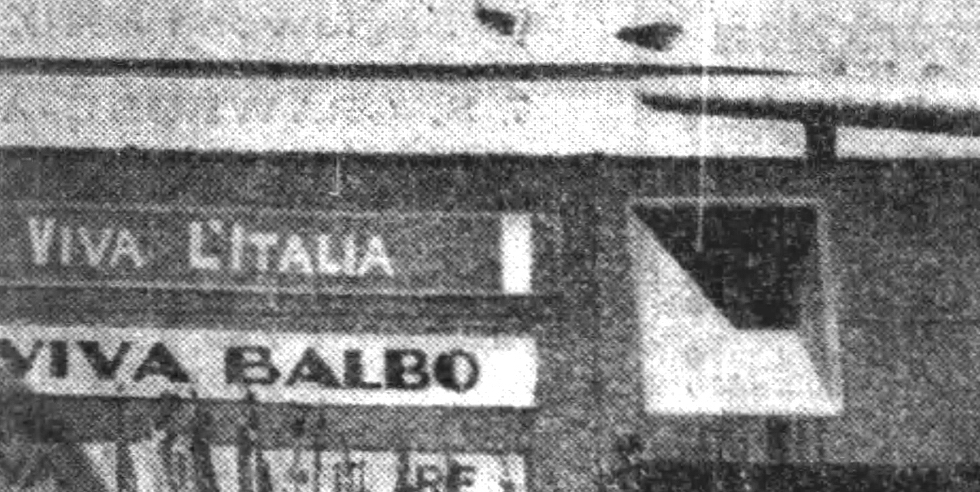
Viva L'Italia! Viva Balbo!
That was Italo Balbo's last hurrah on the American scene.
The column, however, still remains where it was —now that everything else is gone or diasappearing fast.
As for the now weathered inscription:
QUESTA COLONNA
DI VENTI SECOLI ANTICA
ERETTA SUL LIDO DI OSTIA
PORTO DI ROMA IMPERIALE
A VIGILARE LE FORTUNE E LE VITTORIE
DELLE TIREMI ROMANE
L'ITALIA FASCISTA SUSPICE BENITO MUSSOLINI
DONA A CHICAGO
ESALTAZIONE SIMBOLO RICORDO
DELLA SQUADRA ATLANTICA GUIDATA DA BALBO
CHE CON ROMANO ARDIMENTO TRASVOLO L'OCEANO
NELL' ANNO XI
DEL LITTORIO
This column, twenty centuries old, was erected on the beach of Ostia, the port of Imperial Rome, to watch over the fortunes and victories of the Roman triremes. Fascist Italy, with the sponsorship of Benito Mussolini, presents to Chicago a symbol and memorial in honor of the Atlantic Squadron led by Balbo, which with Roman daring, flew across the ocean in the 11th year of the Fascist era.
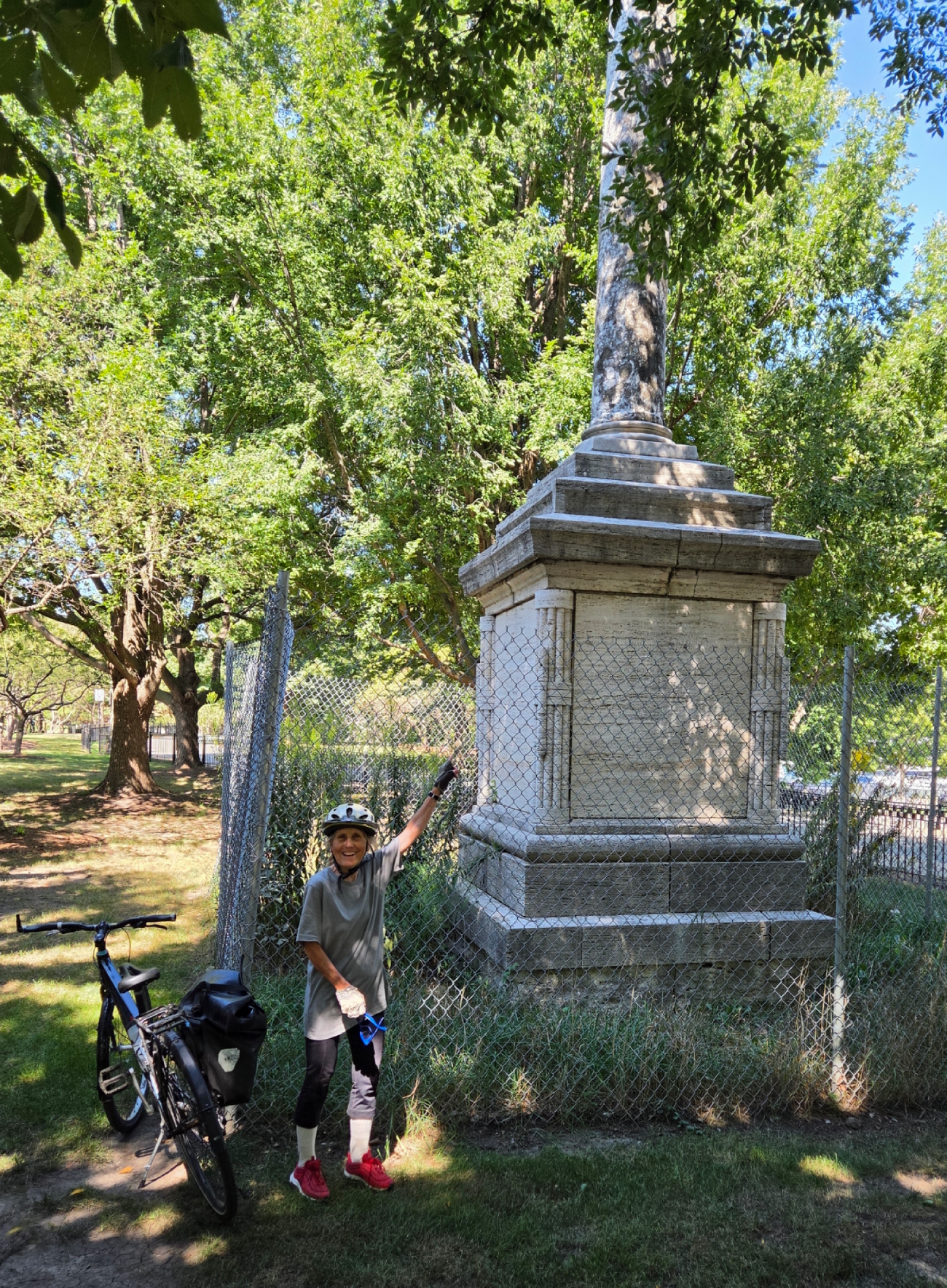
A running leap into the present day...
Diane Dillon, my inside source for All Things Chicago, visits the now much unloved Balbo Column— under constant threat of removal or worse.
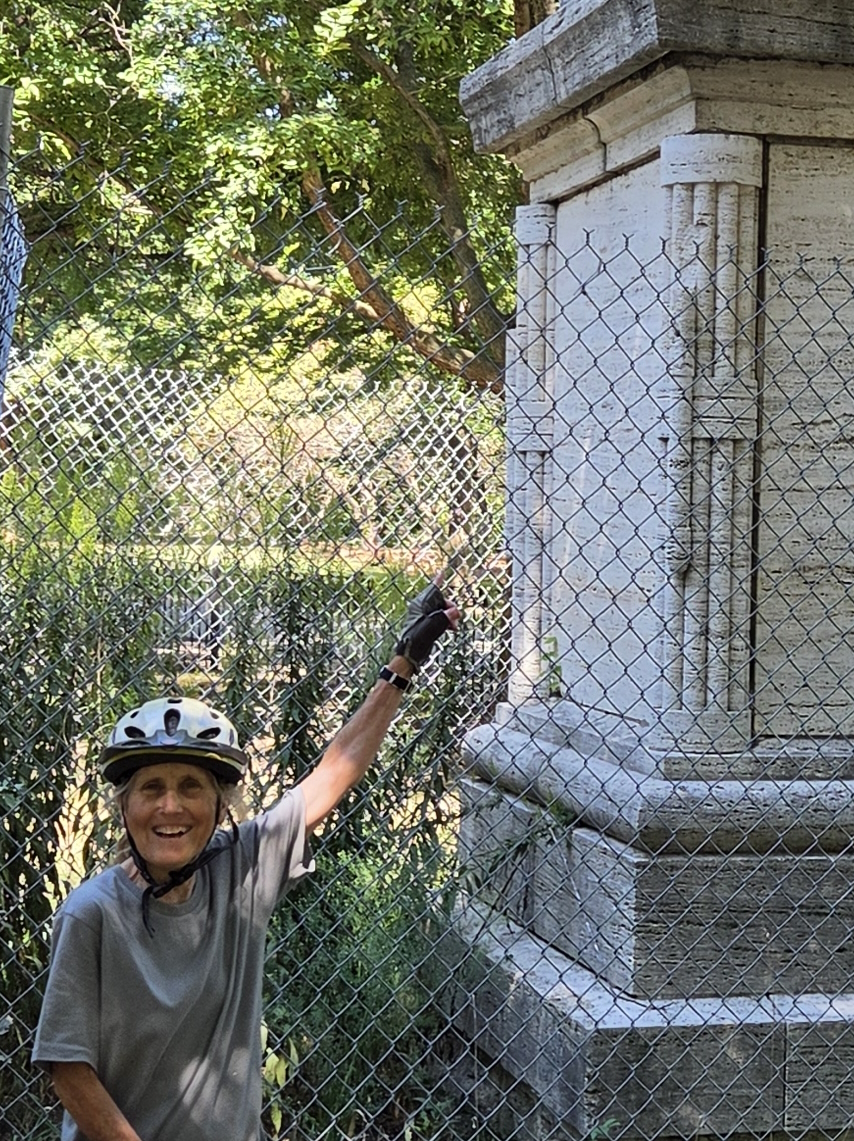
Everyone, however, does not find the prominent fasces quite so cheering nor the lyrical ode to that problematic passage of history.

For decades, Chicago activists— overwhelmingly non-Italian, of course —have set their sights on Balbo Drive and the Balbo Column.
This began right after World War Two, when naming-rights were in hot demand for the latest crop of heroes.
"Chicago boys of Italian descent who fought in Italy do not wish to honor the Fascist who betrayed his own people as well as conducted a war against our country."
Thus spoke Russell Root, a Republican candidate for Mayor in 1947, but he didn't get very far in his election bid either.

In 2018, there was a concerted push to make Balbo Drive over to the pioneering African-American journalist Ida B. Wells, but that hit local Italian opposition and stalled out too.
After the usual negotiations, another nearby thoroughfare was appropriated for Wells, while Balbo Drive remains as it was —and will likely remain for some time to come.

Ida B. Wells launched her momentous career with a self-published critique of Chicago's 1893 Columbian Exposition —the great national celebration where no African-American need apply.

"Falling to his knees, he kissed the ground and cried. Oh, what riches awaited him! He would return to Spain a hero." (Bonnie Bader, 2013)
As we work our way through history, we still hit Christopher Columbus at every turn— more than five centuries after his death.
But who was this Great Navigator, really?
In the United States of America, at least...
FOR MORE ON THE COMPLEX AND CONTROVERSIAL COLUMBUS STORY, SEE:
WHOSE COLUMBUS? WHOSE COLUMBUS DAY?
Related posts
COLUMBUS, MARCONI, BALBO AND MUSSOLINI: Italian Heroes Collide with American Reality - Part 1
At Chicago's 1933-34 Century of Progress Exposition, Guglielmo Marconi, the inventor of the radiotelegraph and Italo Balbo, the aeronautical “Second Columbus” led a brilliantly orchestrated public relations campaign on behalf of Benito Mussolini’s regime.
Fascist Italy commanded a dazzling array of scientific, technological and cultural resources. It channeled them all into a sensational spectacle that astonished and intrigued the American public.

GUGLIELMO MARCONI: Science, Fascism, Antisemitism and What Else?
History has given a free pass to Guglielmo Marconi, who was both a scientific genius and a Fascist ideologue.
There are two stories to tell—first in Italy and then in America.
MUSSOLINI: THE WILD MAN OF EUROPE - Part 1
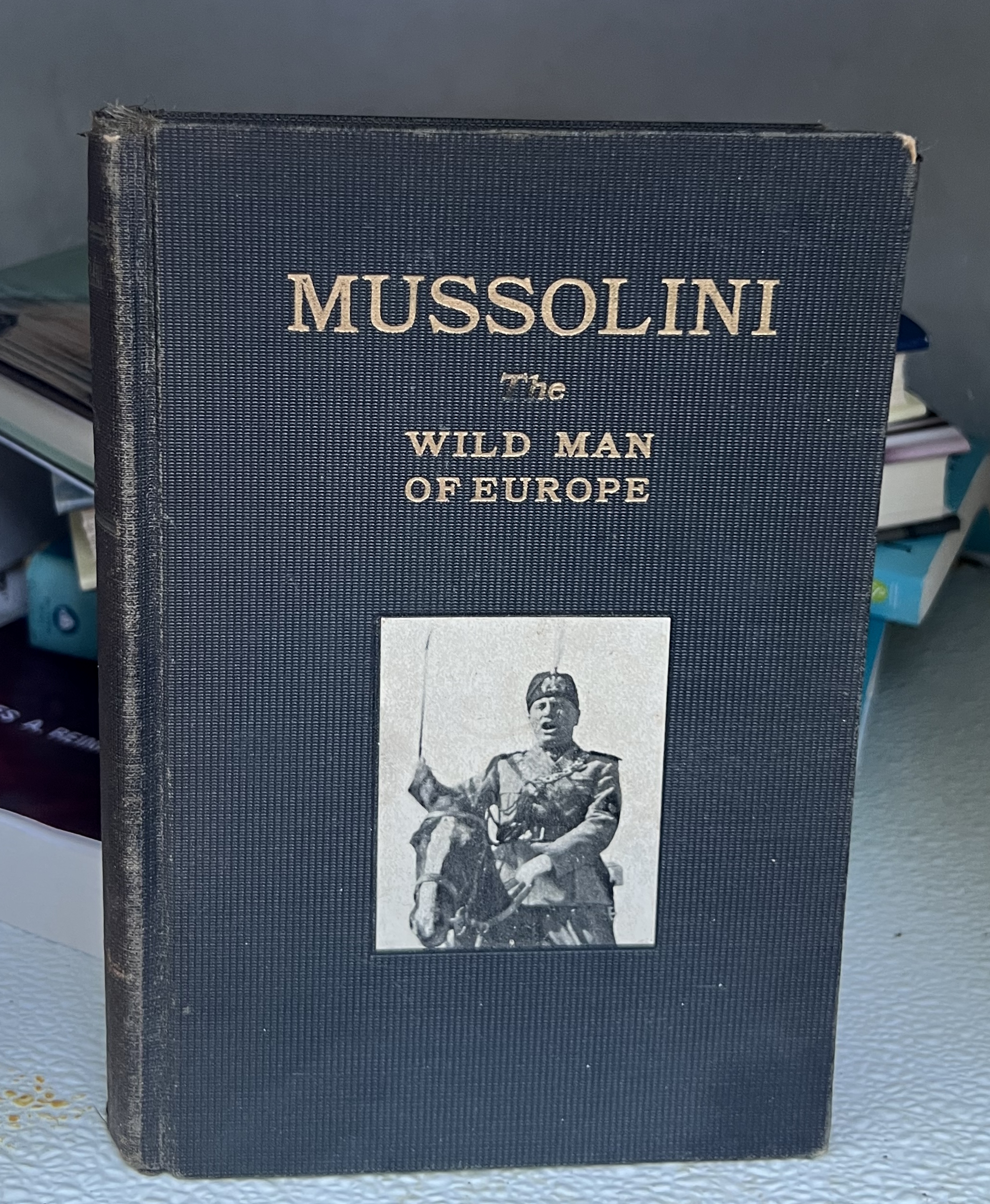
In a "Little Library" in Washington DC, I happened upon "Mussolini: The Wild Man of Europe"— John Bond's eccentric exposé of Benito Mussolini, printed in the Nation's Capital in 1929.
In my first post, "Wild Man, Part 1", Bond helped reveal the inner workings of the Ku Klux Klan in Washington DC, Atlanta GA and Altoona PA.
In "Wild Man, Part 2", we took Bond's book to Fascist Italy and viewed the Duce through the outraged author's eyes.
Here in "Wild Man", Part 3", we bring Bond back to Philo-Fascist America. There we see the Duce lauded by Italian Americans, by Hollywood celebrities and by the mainstream press.
Who was John Bond? A "Militant Freemason", a virulent anti-Catholic and an anti-Mussolini conspiracy theorist.
How about his message? Bond was strange and obsessed but he wasn't always wrong.
MUSSOLINI: THE WILD MAN OF EUROPE - Part 2
In a "Little Library" in Washington DC, I happened upon "Mussolini: The Wild Man of Europe"— John Bond's eccentric exposé of Benito Mussolini, printed in the Nation's Capital in 1929.
In my first post, "Wild Man, Part 1", Bond helped reveal the inner workings of the Ku Klux Klan in Washington DC, Atlanta GA and Altoona PA.
Here in "Wild Man, Part 2", we take Bond's book to Fascist Italy and view the Duce through the outraged author's eyes.
In "Wild Man", Part 3", we bring Bond back to Philo-Fascist America. There we see the Duce lauded by Italian Americans, by Hollywood celebrities and by the mainstream press.
Who was John Bond? A "Militant Freemason", a virulent anti-Catholic and an anti-Mussolini conspiracy theorist.
How about his message? Bond was strange and obsessed but he wasn't always wrong.
MUSSOLINI: THE WILD MAN OF EUROPE - Part 3
In a "Little Library" in Washington DC, I happened upon "Mussolini: The Wild Man of Europe"— John Bond's eccentric exposé of Benito Mussolini, printed in the Nation's Capital in 1929.
In my first post, "Wild Man, Part 1", Bond helped reveal the inner workings of the Ku Klux Klan in Washington DC, Atlanta GA and Altoona PA.
In "Wild Man, Part 2", we took Bond's book to Fascist Italy and viewed the Duce through the outraged author's eyes.
Here in "Wild Man", Part 3", we bring Bond back to Philo-Fascist America. There we see the Duce lauded by Italian Americans, by Hollywood celebrities and by the mainstream press.
Who was John Bond? A "Militant Freemason", a virulent anti-Catholic and an anti-Mussolini conspiracy theorist.
How about his message? Bond was strange and obsessed but he wasn't always wrong.
WORK IN PROGRESS
WHOSE COLUMBUS? WHOSE COLUMBUS DAY? Part 1: It begins with a statue in Philadelphia in 1876
Why is Columbus Day the most controversial of American holidays?
People disagree —often violently —about its past and present meaning.
Here are the facts. Make of them what you will!
***
The story begins in South Philly (then and now) and takes us to the American Civil War and the 1876 Centennial Exposition.
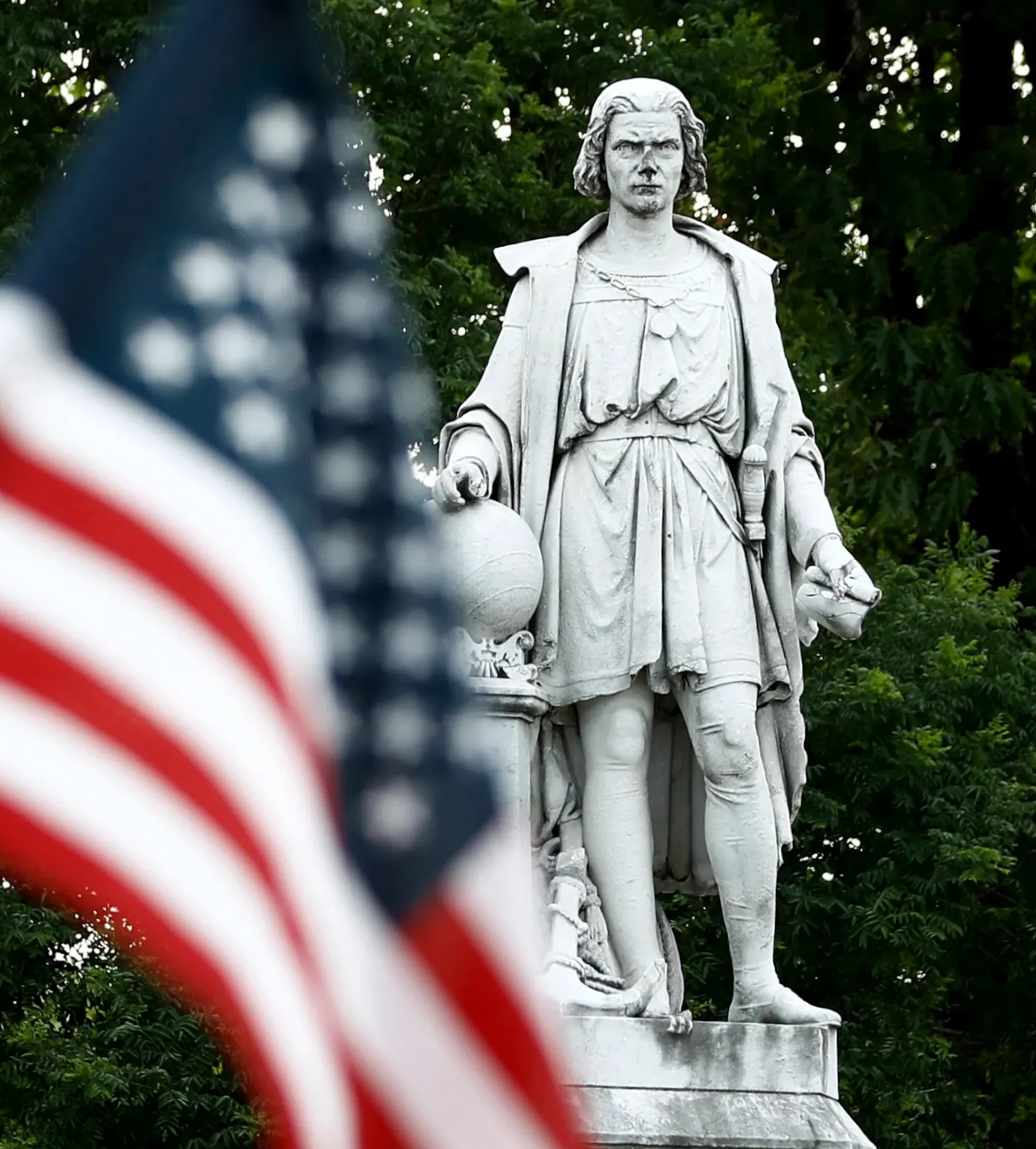
We meet Christopher Columbus (in several incarnations), sculptor Emanuele Caroni and Nunzio Finelli (ideator of Philadelphia’s Columbus Statue, long in Fairmount Park, now in Marconi Plaza).
Lorem ipsum dolor sit amet, consectetur adipiscing elit. Suspendisse varius enim in eros elementum tristique. Duis cursus, mi quis viverra ornare, eros dolor interdum nulla, ut commodo diam libero vitae erat. Aenean faucibus nibh et justo cursus id rutrum lorem imperdiet. Nunc ut sem vitae risus tristique posuere.